

If you're afraid of hormone therapy, I don't think you're being irrational. I think you're responding exactly the way a reasonable person would respond to twenty-four years of confusing and often contradictory public messaging.
Most women I talk to about this can trace the fear to one moment, even if they don't know the details: the summer of 2002, when a major federal trial of hormone therapy was halted early and the news went out that it caused breast cancer and heart attacks. Millions of women stopped their prescriptions within months. A generation of physicians was trained afterward in an environment where hormone therapy was something you talked women out of.
What I want to do here is walk through what that study actually found, what got lost in translation, what the research since has shown, and — importantly — who hormone therapy is not appropriate for. Because there is a version of this conversation currently circulating that swings just as far in the other direction, and I don't find it any more honest than the 2002 panic was.
I'll tell you my own position up front so you can weigh what follows: I believe many women can benefit substantially from hormone therapy, and I think a large number have been underserved by the retreat that followed 2002. That's a clinical view I hold based on the evidence and on how patients present. It is not a claim that hormone therapy is right for everyone, and it is not a claim that it's risk-free. Neither of those things is true.
What actually happened in July 2002
The Women's Health Initiative (WHI) was one of the largest randomized trials ever conducted in postmenopausal women. Its estrogen-plus-progestin arm enrolled 16,608 women and randomized them to either conjugated equine estrogens (0.625 mg/day) plus medroxyprogesterone acetate (2.5 mg/day) or placebo.
It was designed to run 8.5 years. It was stopped at a mean of 5.2 years because the study's monitoring board determined that the risks observed had crossed a pre-set boundary.
The published results reported increases in coronary heart disease, stroke, pulmonary embolism, and invasive breast cancer, along with reductions in colorectal cancer and hip fracture. Overall mortality was unchanged.
The press coverage largely reported the relative risks. And that is where the trouble started.
What the numbers were
Here are the hazard ratios from the 2002 publication:
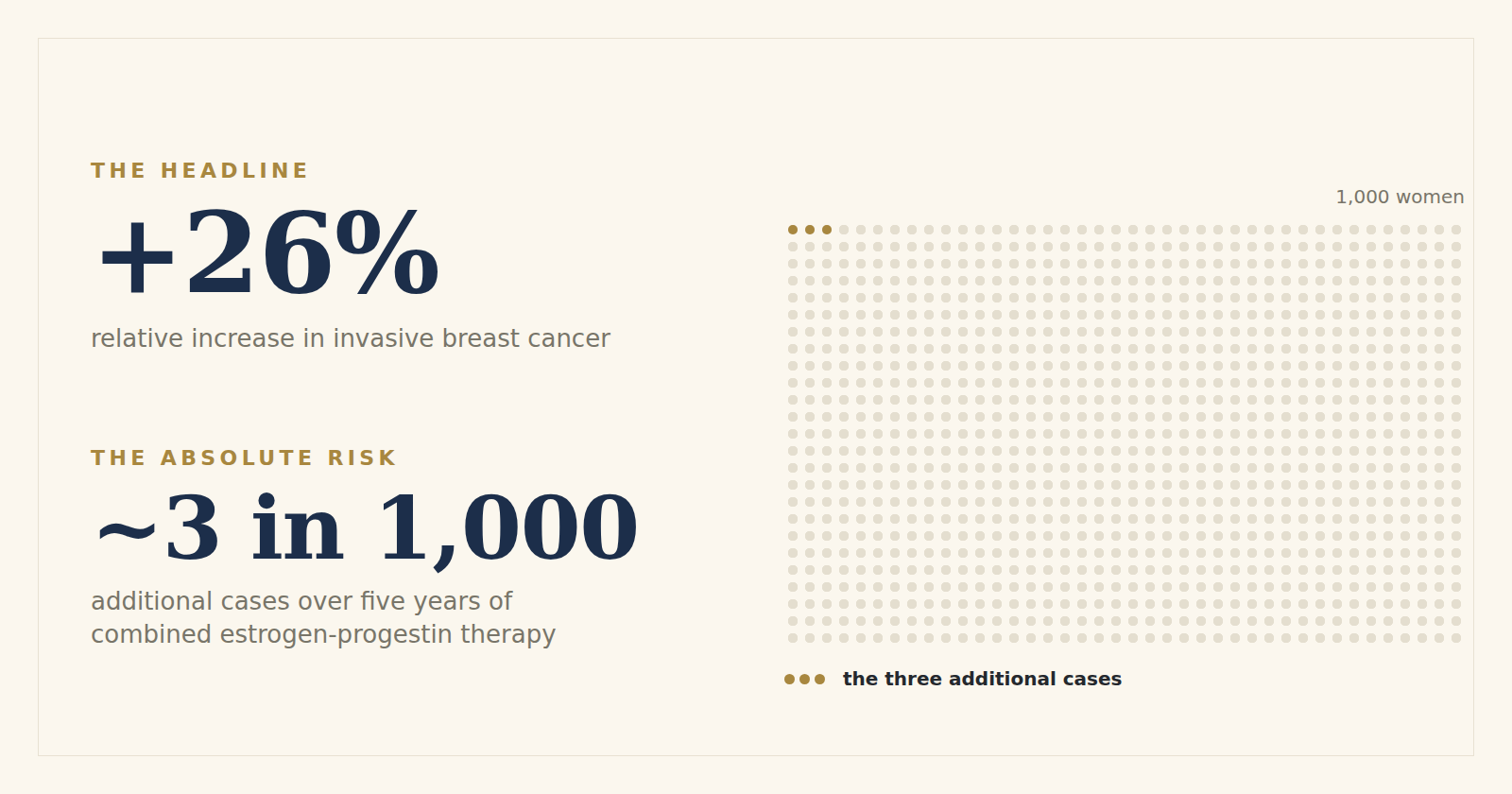
"A 26% increase in breast cancer" is a true statement about that table. It is also, on its own, close to meaningless to a patient trying to decide what to do, because it says nothing about how common the event was to begin with.
The same paper reported the absolute figures, in a sentence that received a fraction of the attention:
"Absolute excess risks per 10,000 person-years attributable to estrogen plus progestin were 7 more CHD events, 8 more strokes, 8 more PEs, and 8 more invasive breast cancers, while absolute risk reductions per 10,000 person-years were 6 fewer colorectal cancers and 5 fewer hip fractures."
Eight additional breast cancers per 10,000 women per year. That is fewer than one additional case per thousand women per year — a real risk, one I discuss with every patient considering combined therapy, and a fundamentally different thing than the number most women carry in their heads.
It's also worth noting that the nominal confidence interval for breast cancer just touched 1.00 at its lower bound. The FDA, in its 2025 review, characterized the original breast cancer result as a statistically non-significant increase in the risk of breast cancer diagnosis. That doesn't make the signal disappear — later and longer follow-up did find elevated breast cancer incidence with estrogen-plus-progestin — but it does tell you the finding was less definitive at the time than the headlines implied.
The population problem
This is the part I most wish had made the news in 2002.
The WHI was not designed to answer "should a 51-year-old with disruptive hot flashes take hormones?" It was designed to test whether hormone therapy prevented chronic disease — heart disease and fractures — in older postmenopausal women. So it enrolled accordingly.
The mean age of participants at enrollment was 63.3 years, in a range of 50 to 79. The average woman in the trial was more than a decade past menopause when she started hormones. Many had never had menopausal symptoms at all; symptomatic women were, in some respects, less likely to enroll in a placebo-controlled trial they might be randomized out of.
That matters biologically. Starting estrogen in a 50-year-old woman with relatively healthy arteries is not the same intervention as starting it in a 70-year-old woman who may already have established atherosclerotic plaque. This idea — that the effect of hormone therapy on the cardiovascular system depends on when you start it — became known as the timing hypothesis, and testing it occupied much of the next fifteen years of research.
There's also a formulation issue. The WHI tested oral conjugated equine estrogens with oral medroxyprogesterone acetate. Those are real drugs still in use, but they are not the only or even the most common options today, and route of administration appears to matter — transdermal estrogen, for instance, is generally understood to carry a lower venous thromboembolism risk than oral.
What the retreat looked like
The response was immediate and enormous.
Prescriptions for menopausal hormone therapy in the U.S. peaked at 92 million in 2000. By July 2003 — twelve months after the WHI publication — total prescriptions had fallen 38%. Prescriptions for the specific combination product used in the trial dropped 66% in the first half of 2003 compared with the same period in 2002.
And it never came back. Research presented at The Menopause Society's 2024 annual meeting found hormone therapy use among U.S. women aged 40 and older was 4.6% in 2007, 2.5% in 2014, and 1.8% in 2023. Even in the age band where symptoms are most common — women 55 to 59 — use fell from 7.3% to 3.8% over that period.
Whatever you think the right prescribing rate is, a two-decade decline to under 2% is not the product of individualized risk-benefit conversations. It's the product of a message that landed hard and never got fully corrected.
What the later research showed
Four lines of evidence changed the picture.
1. The estrogen-alone arm (2004). The WHI had a second trial: 10,739 women who'd had a hysterectomy received conjugated equine estrogen alone, without a progestin, and were followed for about 6.8 years. That arm showed a 39% increase in stroke and a 39% reduction in hip fracture — but coronary heart disease risk was neither increased nor decreased, and breast cancer risk was 23% lower, a difference that was not statistically significant at the time. That is a meaningfully different result from the combined arm, and it suggests the progestin component contributed substantially to the breast cancer signal.
2. The age-stratified reanalysis (2007). A WHI analysis published in JAMA in 2007 examined outcomes by age and by years since menopause. For coronary heart disease, the hazard ratio was 0.76 (95% CI 0.50–1.16) in women less than 10 years past menopause, 1.10 in women 10 to 19 years out, and 1.28 (95% CI 1.03–1.58) in women 20 or more years out, with a significant trend (p=0.02). Total mortality in women aged 50–59 had a hazard ratio of 0.70.
Read that carefully, though: the CHD findings in the younger groups were not statistically significant, and the authors said so. And stroke risk was elevated (HR 1.32) with no significant variation by age or time since menopause. The timing hypothesis got support here. It did not get proof.
3. A trial built to test timing directly (2016). The ELITE trial randomized postmenopausal women — stratified into those less than 6 years past menopause and those 10 or more years past — to oral estradiol with vaginal progesterone or placebo, and measured progression of carotid artery wall thickness. In the early group, estradiol significantly slowed progression (p=0.008). In the late group, it did not. But ELITE measured a surrogate marker of atherosclerosis, not heart attacks, and found no differences in coronary CT measures. It supports the timing concept; it does not establish that hormone therapy prevents cardiac events.
4. Long-term mortality follow-up (2017 and 2020). Following all 27,347 WHI participants for a cumulative 18 years, researchers found no increase or decrease in all-cause, cardiovascular, or total cancer mortality with either regimen. And in the 20-year breast cancer follow-up published in JAMA in 2020, estrogen alone was associated with lower breast cancer incidence (HR 0.78) and lower breast cancer mortality (HR 0.60) among women with prior hysterectomy, while estrogen-plus-progestin was associated with higher incidence (HR 1.28) without a significant difference in mortality.
Where the major societies stand today
The Menopause Society (formerly the North American Menopause Society), in its 2022 hormone therapy position statement, holds that hormone therapy remains the most effective treatment for vasomotor symptoms and the genitourinary syndrome of menopause, and prevents bone loss and fracture. Its central framing: the benefits outweigh the risks for most healthy symptomatic women who are younger than 60 and within 10 years of menopause onset. For women who start more than 10 to 20 years out, or after 60, the statement describes a less favorable balance because absolute risks of coronary disease, stroke, venous thromboembolism, and dementia are higher. It also states hormone therapy does not need to be routinely discontinued at 60 or 65 when there's an ongoing indication and periodic reassessment.
On breast cancer, that statement puts the risk in absolute terms: less than one additional case per 1,000 women per year of use, or roughly three additional cases per 1,000 women when combined estrogen-progestin therapy is used for five years.
ACOG likewise supports hormone therapy for vasomotor symptoms in appropriately selected women without contraindications, and has been vocal that overstated warnings kept women from effective treatment.
The FDA changed course in 2025 and 2026. In November 2025 it announced it would initiate removal of the boxed warnings regarding cardiovascular disease, breast cancer, and probable dementia from menopausal hormone therapy products, and in February 2026 it approved labeling changes across six products in four categories. The endometrial cancer warning for systemic estrogen-alone products remains.
The part where I push back on my own side
Here is where I want to be careful, because the pendulum is swinging and I don't think it should swing all the way.
The FDA's announcement was accompanied by press-release language citing large percentage reductions in cardiovascular disease, Alzheimer's disease, and fracture for women starting therapy within 10 years of menopause. Those figures come from an agency communication, not from a specific trial cited in the release, and several of them go considerably further than the randomized evidence I described above supports. Hormone therapy is not approved, and is not recommended by the major societies, for the prevention of cardiovascular disease or dementia. The Menopause Society's 2022 statement explicitly does not endorse using it to prevent or treat cognitive decline.
The Menopause Society's own response to the FDA announcement was notably measured. It agreed with removing the boxed warning from low-dose vaginal estrogen. On systemic therapy, it said that estrogen "still comes with potential risks in certain individuals that should be reviewed in detail with women initiating therapy," and that comorbidities, personal and family history, symptoms, and preferences all need review.
Other clinicians raised process and messaging concerns. Dr. Lisa Larkin described the shift as "a pendulum swing — from overemphasizing the risks and ignoring the benefits to overemphasizing the benefits," and specifically flagged the risk of oversimplified messaging reaching breast cancer survivors, where she noted the data remain unclear. Oncologists have raised similar concerns about extrapolating to patients on endocrine therapy for breast cancer.
I think those cautions are correct. "The 2002 scare was overblown" and "hormone therapy is safe for everyone" are two very different statements, and only the first one is supported.
Who hormone therapy is not right for
This is the section that should exist in every article on this topic and usually doesn't.
Absolute contraindications to systemic hormone therapy generally include:
- A history of breast cancer or other estrogen-sensitive cancer
- A history of venous thromboembolism (blood clots in the legs or lungs)
- A history of stroke or transient ischemic attack
- Established coronary artery disease
- Active liver disease
- Uncontrolled hypertension
- Unexplained vaginal bleeding — this needs to be evaluated before any hormone therapy is considered, not after
Relative contraindications — meaning the conversation gets more complicated and may still end in "no" — include migraine with aura, controlled hypertension, high triglycerides, a strong family history of hormone-dependent cancer, and elevated baseline cardiovascular or clotting risk.
Beyond contraindications, there are honest limits. Starting systemic hormone therapy for the first time many years after menopause or after age 60 carries a less favorable balance, and that has to be weighed openly. And hormone therapy doesn't treat everything women hope it will — it is not a treatment for obesity, and while it can improve sleep and mood for many women whose symptoms are driven by vasomotor disruption, it is not a substitute for treating a genuine depressive disorder or an untreated sleep apnea.
Systemic versus local vaginal estrogen — a distinction worth knowing
These get discussed as one thing and they are not.
Low-dose vaginal estrogen treats genitourinary symptoms — dryness, pain with intercourse, urinary urgency, recurrent UTIs. According to The Menopause Society's 2020 position statement on the genitourinary syndrome of menopause, serum estrogen levels with low-dose vaginal preparations remain within the normal postmenopausal range, a progestogen is not indicated alongside them, and in clinical trial data of up to one year, endometrial cancer occurred in 0.03% and endometrial hyperplasia in 0.4% — rates consistent with the untreated population.
That's a substantially different risk profile from systemic therapy, and it's why the FDA's removal of the boxed warning from vaginal estrogen products drew broad support even from clinicians who were cautious about the systemic changes. If your symptoms are exclusively genitourinary, local therapy is generally the more appropriate starting point.
What about compounded hormones and "bioidentical" marketing
I'll be direct about this, including where it cuts against my own industry.
Compounded hormone preparations are not FDA-approved finished products. Drug products compounded in accordance with section 503A are exempt from the FD&C Act's new-drug approval requirements, provided the section's conditions are met — a narrow, conditional exemption rather than a general one. Compounded products are not reviewed by the FDA for safety, effectiveness, or quality.
ACOG's 2023 Clinical Consensus states that FDA-approved menopausal hormone therapies are recommended over compounded preparations, and that compounded therapy should not be prescribed routinely when an FDA-approved formulation exists. ACOG also notes that marketing built around the term "bioidentical" implies a natural superiority for which the supporting evidence is lacking, and that salivary and serum hormone testing is not recommended for guiding this kind of prescribing. On pellets specifically, ACOG recommends preparations other than pellet therapy for the delivery of testosterone, citing the lack of safety data and the inability to remove a pellet once placed.
There are legitimate, narrow circumstances where compounding is appropriate — an allergy to an excipient in a commercial product, or a dose or route that isn't commercially available. Those are real, and they're specific. They are not the same as a general claim that compounded is better, and I don't make that claim.
Frequently asked questions
Does hormone therapy cause breast cancer?
Combined estrogen-progestin therapy was associated with an increase in breast cancer incidence in the WHI — about 8 additional cases per 10,000 women per year, which The Menopause Society frames as fewer than one additional case per 1,000 women per year of use. Estrogen alone, in women with prior hysterectomy, was associated with lower breast cancer incidence and mortality in 20-year follow-up. Personal and family history change this calculus, which is why it's an individual conversation.
Was the WHI wrong?
No. The WHI was a well-conducted trial that answered the question it was designed to ask, in the population it enrolled. What went wrong was largely in how the results were communicated — relative risks without absolute risks — and in generalizing findings from women averaging 63 years old to women in their early 50s starting therapy for symptoms.
Is it too late for me to start if I'm past 60?
Starting systemic hormone therapy for the first time after 60, or more than 10 years past menopause, is where the societies describe a less favorable risk-benefit balance. That doesn't automatically mean no, and it doesn't apply the same way to low-dose vaginal estrogen for genitourinary symptoms. It means the conversation needs to be specific to you.
Now that the FDA removed the warnings, is hormone therapy safe?
Removing a boxed warning changes the label, not the biology. The underlying risks — clot risk, stroke risk, breast cancer risk with combined therapy — are still real, still small in absolute terms for most healthy women near menopause, and still dependent on your individual history. The Menopause Society said as much in its own response to the FDA announcement.
Do I have to be on it forever?
No. This comes up constantly, and the honest answer is that duration is a decision you revisit periodically rather than commit to once. The Menopause Society's position is that therapy doesn't need to be stopped arbitrarily at 60 or 65 if there's an ongoing indication and periodic reassessment — but "you can continue" is not the same as "you must."
Where this leaves us
The picture is more nuanced than either the 2002 panic or the current backlash-to-the-backlash. What the evidence supports, as I read it: hormone therapy is the most effective treatment we have for vasomotor and genitourinary symptoms of menopause; for most healthy women under 60 and within 10 years of menopause, the balance favors treatment when symptoms warrant it; the absolute risks are real but small in that group and larger in older women starting later; and there is a specific list of women for whom it isn't appropriate at all.
If you're trying to work out whether what you're feeling is even part of this picture, our companion piece on signs of hormone imbalance in women walks through the symptoms and what testing can and can't tell you.
None of that is a recommendation for you. Whether hormone therapy makes sense in your case depends on your symptoms, your medical history, your family history, and what matters to you — and that's exactly what an initial visit is for. If the answer for you is no, I'll tell you that, and we'll talk about what else there is.
Billie Jean Health is a physician-led telehealth practice serving patients in Texas. My grandmother Billie Jean Reed, who the practice is named for, is 97 and has spent most of her life being told what she should and shouldn't worry about. What I'd want for her — and what I want for my patients — is an accurate picture and a real choice. And as I tell everyone: you are never bothering me. Bring the questions.
This article is for general education and is not medical advice. Whether any treatment is appropriate for you is a decision for you and a physician who knows your history. Billie Jean Health provides care to patients in Texas.