

Last reviewed: September 2026
The short version
Pattern hair loss has two separate things going wrong at once, and almost every product sold for it addresses one of them.
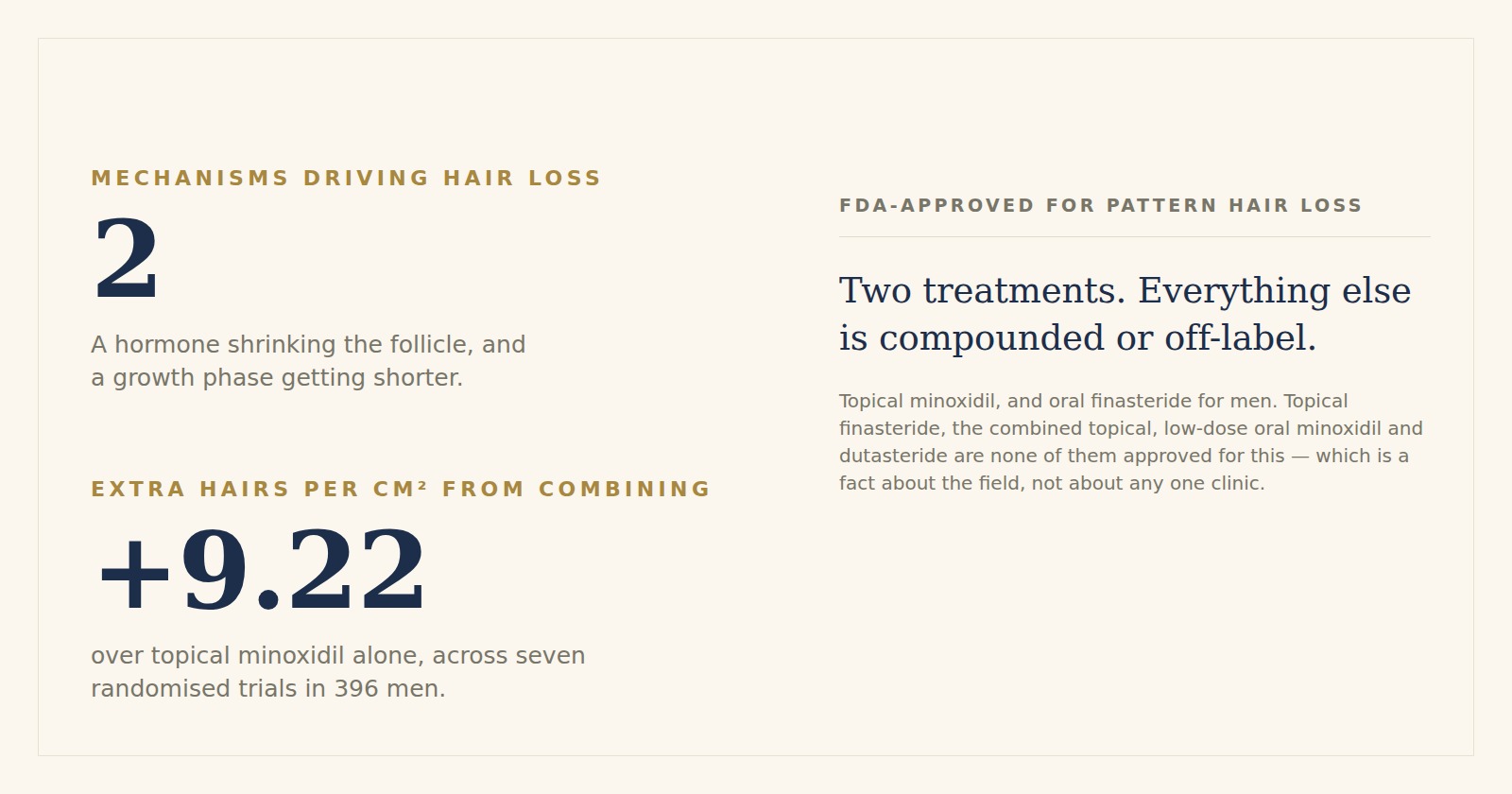
A hormone — DHT — is shrinking the follicles over successive cycles until they produce something too fine and short to cover anything. Separately, the growing phase of each cycle is getting shorter, so there is less hair on the head at any moment even before the thinning is visible.
Minoxidil acts on the second problem and does nothing about the first. Finasteride acts on the first and does nothing about the second. Used alone, each does a respectable and limited amount, and the trials bear that out: as single agents they land within a few hairs per square centimetre of each other.
Used together, they do measurably more — which is the entire argument for treating this as a protocol rather than a product.
What is actually happening to the follicle
Worth two paragraphs, because the mechanism is what makes the rest of this make sense.
Testosterone is converted in the scalp to dihydrotestosterone by an enzyme called 5-alpha-reductase. In genetically susceptible follicles, DHT progressively miniaturises them: each cycle produces a slightly finer, shorter, less pigmented hair, until what is left is barely visible. This is why the pattern is a pattern — the follicles at the crown and temples are the susceptible ones, and the ring around the back and sides largely is not.
At the same time the anagen phase, the part of the cycle in which hair actually grows, is shortening. Fewer hairs are growing at once and each grows for less time before shedding.
Two mechanisms, two drug families. Finasteride and dutasteride block the enzyme, reducing DHT at the scalp. Minoxidil does not touch hormones at all; it acts on the follicle to extend the growth phase. Neither substitutes for the other, and this is exactly why adding a second drug from the same family — two DHT blockers, say — usually adds much less than adding one from the other.
What the combination evidence actually shows
The most directly relevant trial evidence compares a combined topical of minoxidil and finasteride against topical minoxidil alone.
Pooling seven randomised controlled trials in 396 men, the combination produced 9.22 more hairs per square centimetre than minoxidil by itself. Hair diameter improved as well, and blinded photographic assessment favoured the combination, with the effect strongest at the “marked improvement” end of the scale.
Set that against Figure 1 for scale: 9.22 hairs is a meaningful fraction of what any single agent achieves on its own. Adding the second mechanism is not a marginal refinement.
Now the honest part. Those seven trials involved 396 men in total, most ran three to six months, and they were conducted in a handful of countries with varying methods. That is real randomised evidence and it is not a large or long body of it. Hair loss treatment is judged over years, and three-month trials cannot tell you what happens in year three. If you want the general version of this habit — reading what a study actually was rather than what it is described as — it is worth ten minutes here.
The finasteride conversation, without the theatre
This is the reason a large number of men who would benefit from treatment do not start it, and it deserves a straight answer rather than either reassurance or alarm.
A meta-analysis of 15 randomised, double-blind, placebo-controlled trials covering 4,495 men found sexual adverse events in 5.31% of men taking a 5-alpha-reductase inhibitor and 3.05% of men taking placebo — a risk ratio of 1.66. Erectile dysfunction specifically carried a risk ratio of about 2.
Two things are true at once, and most coverage picks one. The increase is real and statistically solid. And roughly three in every hundred men on placebo reported the same symptoms, which means most men who experience this on treatment would have reported it anyway — and also that the drug adds about two cases per hundred.
The authors of that analysis were careful about their own limitations: the adverse effects were self-reported without objective measurement, and most of the included trials were funded by the manufacturer. Take that in both directions. Industry funding tends to understate harms; self-report in a trial where everyone has heard the rumour tends to overstate them.
The reasonable position is that this is a real and quantified risk, small in absolute terms, worth knowing before starting, and worth raising promptly if it happens rather than quietly stopping.
Topical is not the same as risk-free, and the FDA has said so
The usual reassurance is that applying finasteride to the scalp rather than swallowing it keeps it out of the rest of the body. The combination trials above support the mild version of that — they reported no treatment-emergent sexual adverse events. But 396 men over a few months is not a sample in which uncommon events would be expected to appear, and there is now a more specific reason to be careful with the claim.
In April 2025 the FDA issued an alert about compounded topical finasteride, including formulations combined with minoxidil. It described 32 adverse event reports received between 2019 and 2024 — erectile dysfunction, decreased libido, testicular pain, anxiety, depression, brain fog, fatigue, insomnia and suicidal ideation — and noted that most of those reports described symptoms persisting after the product was stopped. The alert states that absorption of finasteride through the skin into the bloodstream is expected, that there is no FDA-approved topical formulation, and that the agency is aware of compounders and telemedicine platforms marketing these products for hair loss.
Adverse event reports are not proof of causation. They are voluntary, unverified, and come without a denominator — 32 reports over six years, against an unknown number of users, is not a rate. But topical, therefore not systemic is not a claim the evidence supports, and a provider offering you a compounded topical should be the one telling you this rather than leaving you to find it.
The alert also flags something rarely mentioned: the product sits on the scalp and can transfer by contact. It should not be handled by anyone who is or may become pregnant.
Most of what works here is compounded or off-label
This surprises people and it is worth stating plainly.
Only two treatments are FDA-approved for pattern hair loss: topical minoxidil and oral finasteride, the latter for men. Everything else in Figure 2 — topical finasteride, the combined topical, low-dose oral minoxidil, dutasteride — is either compounded or a drug approved for something else and used off-label.
That is a fact about this field, not about any particular clinic. Off-label prescribing is legal, common and often the standard of care. But it does mean a few things follow that would not follow for an approved product: the exact formulation is decided by a pharmacy rather than specified by a label, there is no FDA-reviewed prescribing information for the specific combination, and quality depends on who made it. What compounded actually means covers that ground, and it is worth reading before agreeing to anything mixed to order.
The single most useful question to ask any hair loss provider: which of these is FDA-approved, and which am I being given?
Timelines, and the shed nobody warns you about
Hair loss treatment operates on the timescale of the hair cycle, which is slow, and the first visible change is often in the wrong direction.
- Weeks two to eight: increased shedding is common and expected. Pushing follicles into a new growth phase means the old hairs come out first. It is the single most common reason people quit, and it is a sign the medication is doing something.
- Three months: too early to judge anything.
- Six months: the first honest assessment. Slowing of loss is the realistic goal at this point; regrowth, where it happens, is a bonus.
- Twelve months: the real verdict. Most trial endpoints sit here or later.
- Stopping reverses it. Within six to twelve months of stopping, the hair gained is generally lost, and the underlying process resumes where it left off. This is maintenance treatment, not a course.
Take photographs before starting — same spot, same light, same distance, dry hair, once a quarter. Memory is a terrible instrument for gradual change in either direction, and at month six the photographs settle arguments that impressions cannot.
Women: a different workup, not just a different dose
Female pattern hair loss shares the miniaturisation mechanism but almost nothing else about the approach.
Topical minoxidil is FDA-approved for women. Oral finasteride is not, and it is contraindicated in women who are or may become pregnant, because 5-alpha-reductase inhibitors can affect the development of a male fetus — which also means the tablets should not be handled if they are broken or crushed.
More importantly, diffuse thinning in a woman has a longer list of causes worth excluding before anything is prescribed: thyroid disease, iron deficiency, recent illness, pregnancy, rapid weight loss, and androgen excess. Treating the pattern without checking those is how a correctable cause gets missed for two years, which is part of why labs come before treatment.
What does not have the evidence
Briefly, because the market is large and the literature is not.
Biotin corrects hair problems caused by biotin deficiency, which is rare, and does nothing detectable in people who are not deficient. Most hair supplements are combinations of things with the same profile. Devices and light-based treatments have a thinner evidence base than the medications above, and where they show benefit it tends to be modest. None of this is a reason to be rude about them; it is a reason not to substitute them for something with trial data behind it.
When to be seen rather than start a product
- Hair coming out in patches rather than diffusely, which points to a different condition entirely
- Sudden heavy shedding over weeks, particularly after illness, surgery, childbirth or rapid weight loss
- Any redness, scaling, pain, itching or burning of the scalp, or a scalp that looks smooth and shiny where hair used to be — scarring types of hair loss destroy the follicle permanently and are treated urgently and differently
- Hair loss in a woman alongside irregular periods, acne or unusual hair growth on the face or body
- Hair loss alongside fatigue, weight change or other systemic symptoms
- Hair loss in a child or adolescent
Where I land
The reason single products underperform is not that they are bad. It is that pattern hair loss is two problems and each product is one answer.
The other reason is timing. This is a condition where what you can save is worth far more than what you can regrow, and the follicles that have already scarred over are not coming back. The best version of this treatment is unglamorous: two mechanisms, started earlier than feels necessary, photographed quarterly, and continued.
Frequently asked questions
Do minoxidil and finasteride work better together?
The evidence says yes, and the mechanism explains why. They act on different parts of the problem — finasteride reduces the DHT that miniaturises the follicle, minoxidil extends the growing phase of the hair cycle. Pooling seven randomised controlled trials in 396 men, a combined topical produced 9.22 more hairs per square centimetre than topical minoxidil alone, with improved hair diameter and better blinded photographic outcomes. Those trials were mostly three to six months long, so they say more about starting than about year three.
How likely are sexual side effects from finasteride?
A meta-analysis of 15 randomised, double-blind, placebo-controlled trials in 4,495 men found sexual adverse events in 5.31% of men on a 5-alpha-reductase inhibitor and 3.05% on placebo, a risk ratio of 1.66. So the increase is real, and in absolute terms the drug adds roughly two cases per hundred men. The authors noted that the effects were self-reported without objective measurement and that most trials were industry-funded, which cuts in both directions.
Why is my hair shedding more after starting treatment?
Increased shedding in the first two to eight weeks is common and expected. Moving follicles into a new growth phase pushes the old hairs out first, so the visible change arrives before the benefit does. It is the most common reason people stop, and it is a sign the medication is acting. The first honest assessment is at six months, and the real verdict at twelve.
Is topical finasteride FDA-approved?
No. Only topical minoxidil and oral finasteride are FDA-approved for pattern hair loss in the United States, and oral finasteride for men only. Topical finasteride, combined minoxidil-finasteride topicals, low-dose oral minoxidil and dutasteride are all either compounded or prescribed off-label. In April 2025 the FDA issued an alert about compounded topical finasteride, describing 32 adverse event reports received between 2019 and 2024 and stating that absorption through the skin into the bloodstream is expected. Off-label and compounded prescribing is legal and common, and it means the formulation is set by a pharmacy rather than an FDA-reviewed label — so it is worth knowing which category anything you are given falls into.
Is topical finasteride safer than the tablet?
Less of it reaches the rest of the body, and the randomised combination trials reported no treatment-emergent sexual adverse events — but those trials covered 396 men over a few months, which is too small and too short to detect uncommon events. The FDA's April 2025 alert states that absorption of finasteride through the skin into the bloodstream is expected, and describes reports of the same systemic effects seen with the tablet, most of which were said to persist after stopping. Adverse event reports are voluntary and unverified and do not establish a rate, but “topical, therefore not systemic” is not supported.
What happens if I stop?
The hair gained is generally lost within six to twelve months, and the underlying process resumes. Both minoxidil and the 5-alpha-reductase inhibitors work only while being used. This is maintenance treatment rather than a course of treatment, which is worth deciding about honestly at the start rather than discovering later.
Does finasteride work for women?
It is not FDA-approved for female pattern hair loss and is contraindicated in women who are or may become pregnant, because 5-alpha-reductase inhibitors can affect the development of a male fetus. Topical minoxidil is approved for women. More importantly, diffuse thinning in a woman warrants excluding thyroid disease, iron deficiency, recent illness, rapid weight loss and androgen excess before anything is prescribed, because several of those are correctable.
Before you go
If you have been using one product for a year and wondering why it has not done more, the likeliest answer is not that it failed. It is that it was only ever addressing half of what is happening.
This article is for general education and is not medical advice for any individual. It doesn't establish a physician-patient relationship. Talk to a licensed clinician about your own situation.