

Patients ask me some version of this every week: Do I really need bloodwork first? I already know how I feel.
It's a fair question, and the answer is short. Labs aren't a hoop. They change three things: whether a treatment is safe for you, which treatment is the right one, and how anyone will know later whether it's working. Without them, a prescriber is making an educated guess and asking you to carry the risk of being wrong.
I'm Dr. Lauren Leavitt. I spent about fifteen years in emergency medicine before starting Billie Jean Health, and emergency medicine teaches you that the story a patient tells and the story their bloodwork tells are frequently two different stories — and the gap between them is where people get hurt.
What labs catch before treatment starts
Symptoms overlap. Fatigue, weight that won't move, brain fog, low mood, poor sleep — these are the final common pathway of an enormous number of conditions. Bloodwork is how you tell them apart.
Thyroid disease that looks exactly like a hormone problem. Hypothyroidism produces fatigue, weight gain, cold intolerance, low mood, and dry skin — nearly the list people bring to a hormone consultation. It's also common: a study in the Journal of the Endocrine Society estimated hypothyroidism in roughly 9.6% of the US population, with the untreated share in claims data rising from 11.8% in 2012 to 14.4% in 2019. A TSH is one line on a panel, and it occasionally reorganizes the entire visit.
Anemia. Low hemoglobin causes exactly the tiredness and exercise intolerance that gets attributed to hormones or aging — and it has causes that matter enormously, including iron deficiency from blood loss, kidney disease, and B12 deficiency.
Kidney and liver function, which change dosing and safety. The prescribing information for semaglutide, for example, carries warnings including acute kidney injury from volume depletion — a real concern in a medication whose common side effects are nausea, vomiting, and reduced fluid intake. The labeling referred to here is that of the FDA-approved semaglutide product; Billie Jean Health dispenses compounded semaglutide, and compounded medications are not FDA-approved and have not been evaluated by the FDA for safety, effectiveness, or quality. The warnings are cited because they describe what is known about the active ingredient, not because they describe an FDA review of a compounded preparation. And kidney disease is often already there: the CDC estimates more than 1 in 7 American adults has chronic kidney disease, and that as many as 9 in 10 don't know it.
An already-elevated hematocrit. Testosterone stimulates red blood cell production, so where your red cell count starts matters. The AUA guideline advises measuring hemoglobin and hematocrit before offering testosterone therapy and considering withholding treatment if hematocrit is above 50% until that's explained — an elevated starting point can point to sleep apnea, smoking, lung disease, or a blood disorder that deserves an answer of its own.
Undiagnosed diabetes. Per the CDC, about 40.1 million Americans have diabetes, and roughly 27.6% of adults with diabetes — about 11 million people — are undiagnosed. An A1c costs almost nothing and can redirect a weight consultation into something considerably more important.
There's a pattern here: most of what labs catch is silent. That's the entire point. If it announced itself, you wouldn't need the test.
Why the baseline matters even when everything is normal
Here's the part that's easy to skip past: a normal lab panel before treatment isn't a wasted test. It's the reference point that makes every future test interpretable.
Say your hematocrit is 48% a year into hormone therapy. Is that a problem? It depends entirely on whether you started at 42% or at 47%. One is a meaningful trend; the other is noise. Without the first number, nobody can tell you which. The same logic applies across the panel: kidney function that has drifted, a PSA that has moved, a cholesterol pattern that shifted after a weight change. Medicine reads change better than it reads snapshots, and change requires a starting point. The labs aren't only for the diagnosis — they're for the next two years of decisions.
The "your labs are normal" problem
This one deserves real honesty, because it's where a lot of patients have been failed and where a lot of marketing rushes in.
If you've been told your labs are normal but you feel anything but, it helps to understand what "normal" means on a lab report. It doesn't mean "healthy." It means "inside the interval this laboratory calculated."
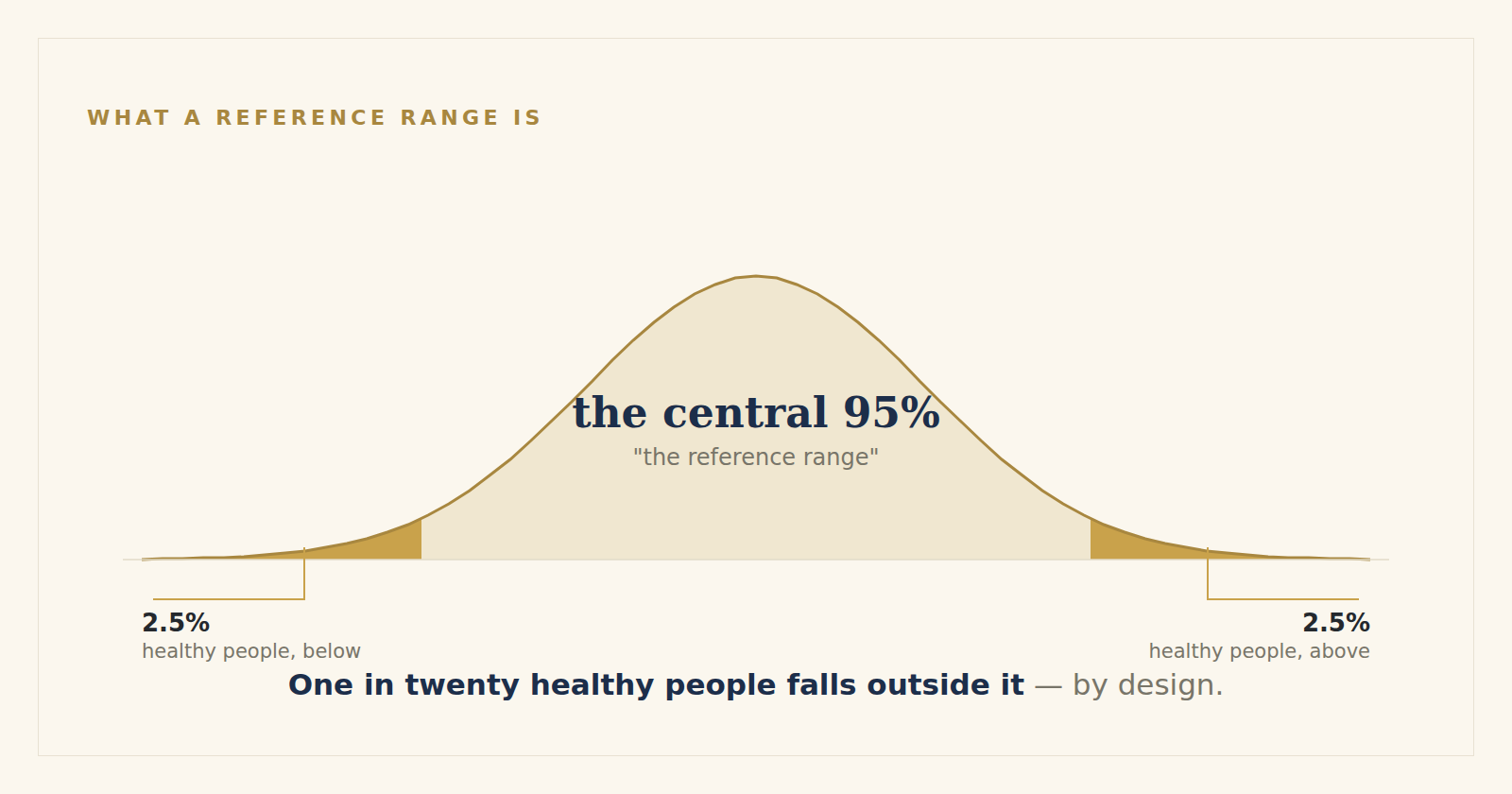
Reference intervals are built to a standard: the Clinical and Laboratory Standards Institute recommends sampling at least 120 individuals from a defined reference population and reporting the central 95% of their results, from the 2.5th to the 97.5th percentile. Which produces a consequence that surprises most people:
By design, roughly 5% of perfectly healthy people fall outside the reference range for any given test. Not because they're sick. Because that's how the arithmetic works.
The effect compounds across a panel. As a 2024 review in the British Journal of Biomedical Science points out, when a disease-free person has ten tests run, the probability that all ten land inside their reference intervals is only about 60%. A flagged value on a broad panel is often statistics rather than pathology — which is why a physician should interpret it, not a highlighted number.
Reference ranges are also population-based and frequently age- or sex-partitioned, and they vary by laboratory and assay. Testosterone is the cleanest illustration: the harmonized range for healthy, non-obese men aged 19–39 is 264 to 916 ng/dL — wide enough that two men inside it can be in very different places — and in July 2026 the Endocrine Society noted that non-standardized assays mean the same blood sample can read "low" at one lab and "normal" at another. So the accurate translation of "your labs are normal" is: your results fall inside a statistical interval derived from a reference population, measured on this lab's assay. That rules certain things out. It isn't a verdict on how you feel.
But "optimal" isn't a magic word either
I want to be careful here, because there's a version of the argument above that gets used badly.
Laboratory medicine draws a distinction between a reference interval — a description of how a healthy population distributes — and a clinical decision limit, a threshold established by clinical studies because it's associated with a specific risk or outcome. Hemoglobin A1c is the classic example: the numbers that define diabetes risk are decision limits from outcome research, not percentiles from a healthy sample. For a few markers we have well-studied decision limits. For many of the markers marketed as needing "optimization," we don't.
So a normal result doesn't dismiss your symptoms — and pushing a number toward an unvalidated target isn't automatically treatment. What a normal panel should produce is a better differential, not a bigger number. If your thyroid, blood count, metabolic panel, and hormones are all reasonable and you still feel terrible, the answer isn't to keep testing until something is out of range. It's to look harder at sleep, medications, alcohol, mental health, and the things that don't show up in a tube. That's a less satisfying answer than a prescription. It's also more often the correct one.
How often labs get rechecked, and why
Baseline labs answer "should we start." Follow-up labs answer "is this doing what we intended, and is anything drifting."
Intervals vary by treatment, and your physician should tell you yours specifically. As one published example: the AUA guideline recommends measuring testosterone every 6 to 12 months during therapy and treating a hematocrit of 54% or higher as warranting intervention, and most guideline-based approaches reassess in the first 3 to 6 months after starting hormone therapy, then at least annually if stable.
The principle underneath is more useful than any single interval: you recheck when a result would change what you do. Early, because that's when dose adjustments happen. Then periodically, because slow drift is invisible from the inside — nobody feels their hematocrit climbing. Which points at something worth saying plainly: if a treatment plan has no scheduled recheck, then either nothing about it is expected to change, or nobody is planning to look.
How lab draws work when your care is by telehealth
Telehealth doesn't mean testing gets skipped. It means the visit happens by video and the blood draw happens somewhere convenient to you — typically a nearby patient service center for a national laboratory, a local draw site, or in some situations mobile phlebotomy. Results route back to your physician, who goes over them with you.
Texas law is clear that the delivery method doesn't lower the bar. Under the Texas Occupations Code, a health professional providing a service by telemedicine is subject to the same standard of care that would apply in an in-person setting. A physician who couldn't meet that standard remotely isn't permitted to try. Telehealth isn't "medicine with fewer steps" — it's the same medicine, with the visit unbundled from the building.
What it means when a service skips this
I'm not going to name anyone, and I'm not interested in a fight. But you should understand the trade being made on your behalf.
When a service prescribes without testing, it hasn't discovered that labs are unnecessary. It has decided that the small number of people the panel would have caught — the undiagnosed thyroid disease, the kidney function nobody checked, the hematocrit that was already high, the diabetes hiding behind the fatigue — are an acceptable cost of a faster checkout. That may be a rational business decision. It's also a decision about your safety, made by someone who has never met you, usually without telling you it's being made.
This isn't hypothetical. A 2022 research letter in JAMA Internal Medicine described investigators contacting seven direct-to-consumer testosterone platforms as a 34-year-old man with fatigue, low libido, normal testosterone levels, and stated interest in future fertility. Six of the seven offered him testosterone therapy. One asked about his cardiovascular history or fertility goals.
When something is easy, it's worth asking what got removed to make it easy. Careful care is slower, though not much — usually a lab draw and a few days.
Frequently asked questions
Do I really need bloodwork before starting a weight loss medication?
A physician needs your kidney and liver function, A1c, blood count, and thyroid status before prescribing — to prescribe safely, and to know where your symptoms are coming from. GLP-1 medications carry warnings including acute kidney injury from volume depletion, which matters in a medication that commonly causes nausea and reduced fluid intake. Those warnings come from the labeling of the FDA-approved products. Where a treatment is a compounded preparation, note that compounded medications are not FDA-approved and have not been evaluated by the FDA for safety, effectiveness, or quality.
My primary care doctor ran labs recently. Do I have to repeat them?
Often not — bring them either way. Results from roughly the last six to eight months can usually be used in place of a new draw. Two things to expect even so: panels that weren't ordered may still need to be added, and hormone panels in particular are rarely part of a routine physical, so there is often a gap even when recent bloodwork exists. Send what you have before your visit and we'll tell you what, if anything, is still needed.
What does a baseline panel usually include?
Commonly: a complete blood count with hematocrit, a comprehensive metabolic panel, a lipid panel, hemoglobin A1c, and thyroid function. Hormone testing is added when hormone concerns are part of the visit — and for men, that means early-morning fasting testosterone measurements, repeated on a second day.
My labs came back "normal." Does that mean nothing is wrong?
No. It means your results fall within a statistical interval built from a reference population — one that by design excludes about 5% of healthy people. Normal results rule some things out and leave other explanations open. The right next step is a better conversation, not more tests for their own sake.
Can I get labs done if I'm being seen by telehealth?
Yes. You'll typically go to a nearby patient service center or draw site, or in some cases arrange a mobile draw, and results come back to your physician for review with you.
Where this comes from
I named this practice for my grandmother, Billie Jean Reed, who is 97. Watching her age well taught me that health is mostly a long series of unglamorous, well-timed decisions, and that those decisions get better when someone is paying attention to the details.
Labs are how a physician pays attention. They aren't the interesting part of the visit — they're the part that makes the interesting part safe. If you're weighing whether a treatment makes sense for you, that's what an initial visit is for. And if a question comes up between visits, ask it. You're never bothering me.
This article is for general education and is not medical advice. Whether any treatment or test is appropriate for you is a decision for you and a physician who knows your history. Billie Jean Health provides care to patients in Texas.