

If you searched "low testosterone symptoms," you probably already have a list in your head: tired all the time, foggy, sleeping badly, not feeling like yourself.
Those symptoms are real. They're also, on their own, a poor test for low testosterone. Fatigue, low mood, and poor concentration are among the most common symptoms in medicine, and they point in dozens of directions. That's why the major guidelines — the American Urological Association and the Endocrine Society — say the diagnosis requires symptoms plus two low early-morning blood tests, and a search for whatever might be lowering your testosterone in the first place.
I'm Dr. Lauren Leavitt. I spent about fifteen years in emergency medicine before founding Billie Jean Health, and emergency medicine leaves you with a habit: you don't treat a number until you understand where it came from.
What testosterone actually does
Testosterone is produced mostly in the testes under instruction from the brain: the hypothalamus signals the pituitary, the pituitary releases luteinizing hormone (LH) and follicle-stimulating hormone (FSH), and the testes respond. It's a loop — a thermostat, more or less — and when testosterone rises, the brain dials the signal back.
Beyond reproduction, testosterone contributes to red blood cell production, bone density, and lean muscle mass. Those same systems are where the side effects of treatment show up, which is why monitoring looks the way it does. And testosterone follows a daily rhythm, highest in the early morning: a draw at 4 p.m. isn't measuring the same thing as a draw at 8 a.m.
The symptom picture — and how nonspecific most of it is
The AUA guideline lists the associated signs and symptoms across three clusters — physical, cognitive/mood, and sexual. The Endocrine Society's guideline does something more useful: it sorts them by how much diagnostic weight they carry.
Look at that last group again. Those are the symptoms most men come in with. They're also the symptoms of poor sleep, depression, thyroid disease, anemia, untreated diabetes, chronic stress, alcohol use, and a dozen medications. A questionnaire that scores those items will flag a very large fraction of the men who take it. It has to — that's what the questions ask about.
So when a clinic tells you that you have low testosterone on the strength of a questionnaire, or a questionnaire plus one afternoon blood draw, the honest description is that they haven't finished the evaluation.
It also helps to know how common this actually is. In the Boston Area Community Health survey, published in the Journal of Clinical Endocrinology & Metabolism in 2007, about 5.6% of men aged 30 to 79 had low testosterone accompanied by clinical symptoms; in men over 70, about 18.4%. It rises with age, and it is not the default explanation for feeling run down in your thirties.
Why one blood test is not a diagnosis
This is the part I'd most like men to take away. AUA Statement 2 is a Strong Recommendation, Grade A: "The diagnosis of low testosterone should be made only after two total testosterone measurements are taken on separate occasions with both conducted in an early morning fashion." The AUA supports a total testosterone below 300 ng/dL as a reasonable cutoff, and Statement 3 adds that the clinical diagnosis is made only when low levels are combined with symptoms and/or signs. The Endocrine Society is equally explicit: measure total testosterone on two separate mornings when the patient is fasting, using an accurate, ideally CDC-certified assay.
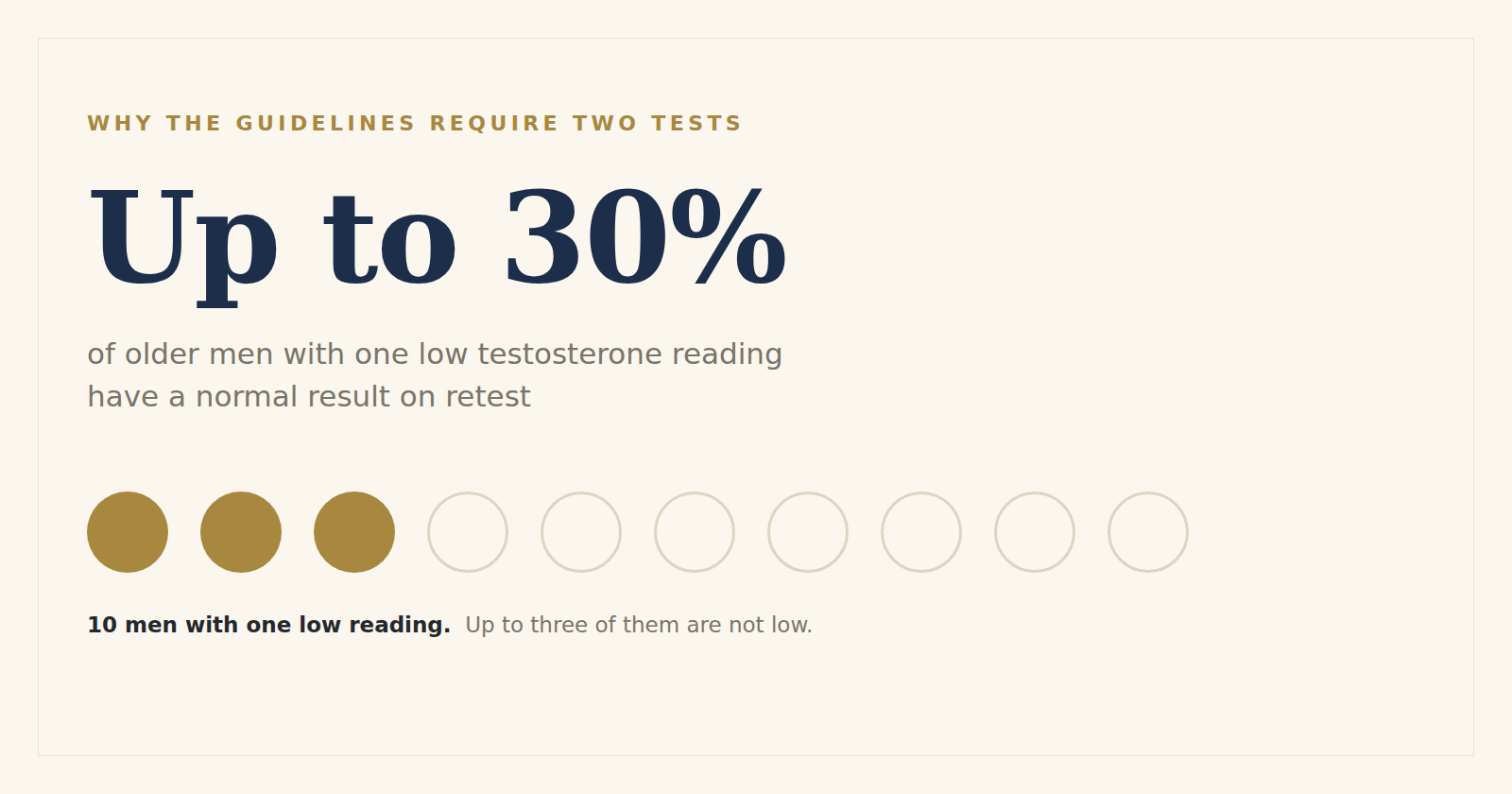
Why two? Because a single value is a noisy measurement. A 2023 JCEM review of the evaluation of men over 50 puts a number on it: up to 30% of older men with a low serum testosterone concentration have a normal value on repeat testing. Not because anyone erred — because testosterone moves with the time of day, acute illness, a bad night's sleep, food, and the assay the lab happens to run. On that last point, the Endocrine Society was blunt in July 2026: non-standardized assays mean the same blood sample can read "low" at one lab and "normal" at another, producing both overdiagnosis and underdiagnosis.
When a clinic skips the second morning test, here's what can happen: a man whose true testosterone is normal starts a Schedule III controlled substance he may not need, for a symptom that had a different cause, and the actual cause goes unaddressed for another year.
The causes worth ruling out before anyone writes a prescription
This is the step most often skipped, and it's what separates an evaluation from a transaction. A good portion of low testosterone in men under 60 is secondary and potentially reversible — the testes are fine, and the signal from above has been turned down by something else.
Excess weight. A 2025 JCEM review explains that obesity-related reductions in sex hormone-binding globulin (SHBG), testosterone's main carrier protein, are primarily responsible for the measured reduction — a functional problem, not a structural one. Men with type 2 diabetes show testosterone reduced by roughly 57 to 86 ng/dL compared with men without, and weight loss moves it back in proportion to the amount lost. The authors are direct: testosterone is not indicated for reduced levels in men with overweight and obesity unless there's also true pathological hypogonadism. The 2026 Endocrine Society statement agrees, naming weight loss as first-line here.
Obstructive sleep apnea. Sleep apnea is strongly associated with low testosterone and is dramatically underdiagnosed - a 2025 analysis in Respiratory Medicine estimated roughly 80.6 million US adults were living with OSA in 2024, about 39% of men. Treating it with CPAP has not been shown to raise testosterone, so it belongs on this list as something to diagnose and treat on its own terms - and because untreated severe sleep apnea is on the Endocrine Society's list of conditions in which testosterone therapy should be avoided.
Medications and alcohol. Opioids and glucocorticoids both suppress the hypothalamic-pituitary-gonadal axis — opioid-induced androgen deficiency is well enough described to have its own name and its own literature. Chronic heavy alcohol use affects the axis at multiple points; a 2024 meta-analysis in Andrology examined this specifically. This part is a history review, not a lab test, and it takes four minutes.
Thyroid disease, poorly controlled diabetes, and elevated prolactin. Thyroid dysfunction produces almost exactly the symptom list men attribute to testosterone. Elevated prolactin can signal a pituitary issue — which is why AUA Statement 7 (Strong Recommendation) says prolactin should be measured when testosterone is low and LH is low or low-normal.
None of this is exotic: a history, a medication list, and a handful of blood tests. But it's the difference between "your number is low, here's a prescription" and "your number is low — let's find out why."
What a thorough evaluation includes
An evaluation consistent with the guidelines generally involves:
- A real history — symptoms, sleep, weight trajectory, alcohol, medications and supplements, testicular history, and whether you want children.
- Two early-morning, fasting total testosterone measurements on separate days.
- Free testosterone or SHBG when the total sits near the borderline, or when something in your history is likely shifting SHBG.
- LH — a Strong Recommendation, Grade A. It distinguishes a testicular problem from a signaling problem, which changes what happens next — and prolactin when LH is low or low-normal.
- Complete blood count with hematocrit, because testosterone raises red cell production and you need to know where you started.
- PSA in men over 40, before therapy, per AUA Statement 12.
- The metabolic picture — A1c, lipids, thyroid, kidney and liver function — which both cause symptoms and change what's safe.
What therapy actually involves
If the evaluation supports treatment, be clear-eyed about what you're agreeing to.
Testosterone is a Schedule III controlled substance under the Controlled Substances Act, alongside the other anabolic steroids Congress scheduled in 1990 and 2004 — a serious medication with real monitoring requirements, not a wellness product. Treatment is also typically long-term: exogenous testosterone suppresses your own production through that same feedback loop, so stopping generally means symptoms return, sometimes after a stretch of feeling worse while the axis recovers. Men deserve to know that before the first dose, not after the third refill.
Monitoring isn't optional. The AUA recommends adjusting dosing to reach the middle tertile of the normal range (roughly 450–600 ng/dL for most labs), measuring testosterone every 6–12 months on therapy, and treating a hematocrit of 54% or higher as warranting intervention — with therapy held at baseline if hematocrit is already above 50% and unexplained. Most guideline-based approaches reassess symptoms, testosterone, and blood counts at 3 to 6 months after starting, then at least annually if stable, with prostate monitoring individualized by age and risk.
Some testosterone preparations are dispensed as compounded medications, which are not FDA-approved finished products and have not been evaluated by the FDA for safety or efficacy; any discussion of how they work refers to the general mechanisms of the active ingredient.
On benefit, I'd rather be accurate than persuasive. AUA Statement 15 says the evidence is inconclusive as to whether testosterone therapy improves cognitive function, energy, fatigue, or quality of life; it notes therapy may improve depressive symptoms, on moderate-quality evidence. In clinical trials, on average, results have been mixed and modest for the very symptoms that bring most men in — and results vary.
What the cardiovascular evidence shows now
For years the honest answer was "we don't know." That improved in 2023, with TRAVERSE in the New England Journal of Medicine. It randomized about 5,200 men aged 45–80 with hypogonadal symptoms, two fasting morning testosterone levels below 300 ng/dL, and existing cardiovascular disease or high risk for it. Over a mean follow-up of roughly 33 months, a primary cardiovascular event occurred in 182 men (7.0%) on testosterone gel versus 190 (7.3%) on placebo — hazard ratio 0.96, 95% CI 0.78–1.17, meeting the noninferiority threshold.
What it did not show matters just as much. Treated men had higher rates of atrial fibrillation (3.5% vs 2.4%), acute kidney injury (2.3% vs 1.5%), and pulmonary embolism (0.9% vs 0.5%), and a substudy found more fractures (3.5% vs 2.5%). The trial used a daily transdermal gel in men who met strict diagnostic criteria — it isn't a safety endorsement for men who don't.
The FDA responded on February 28, 2025: it removed boxed-warning language about cardiovascular risk, kept the "Limitation of Use" stating these products aren't established as safe and effective for age-related hypogonadism, and added a blood pressure warning to products that did not already carry one. Long-term prostate safety remains unestablished.
The fertility conversation
If there's one thing I won't let a man start therapy without understanding, it's this.
Exogenous testosterone suppresses the brain's signal to the testes. FSH and LH fall, and intratesticular testosterone — which must run far higher than blood testosterone for sperm production to work — falls with them. The result is suppressed spermatogenesis. That's not a rare side effect; it's the mechanism, and it's reliable enough that testosterone has been formally studied as a male contraceptive. In a WHO Task Force study of 271 men receiving weekly testosterone enanthate, 65% were azoospermic at six months.
Recovery after stopping is usual but neither immediate nor certain. An integrated analysis by Liu and colleagues in The Lancet in 2006 found a median of about 3.4 months to recover a sperm concentration of 20 million/mL, with roughly 90% recovering within 12 months — though return to a man's own baseline density was less consistent.
The AUA is unambiguous about men who are trying to conceive right now — Statement 23, Strong Recommendation, Grade A: testosterone should not be prescribed to men who are currently trying to conceive. Men who aren't trying yet but think they might want to be are covered by a separate and more qualified statement — Statement 10, Moderate Recommendation, Grade B: men interested in future fertility should have a reproductive health evaluation before treatment. There are other approaches for men who want both symptom management and fertility — they require a conversation, not a checkbox.
Who shouldn't take testosterone
Guidelines advise against starting therapy in men with breast or prostate cancer, an elevated PSA or palpable prostate nodule pending evaluation, an already-elevated hematocrit, untreated severe obstructive sleep apnea, a recent cardiovascular event (the Endocrine Society guideline's window is the prior 6 months), thrombophilia, uncontrolled heart failure, or a desire to conceive in the near term. None of these are permanent disqualifications in every case — several are simply "not yet, let's fix this first."
Frequently asked questions
Does a testosterone level below 300 ng/dL mean I have low testosterone?
Not by itself. The AUA uses 300 ng/dL as a reasonable cutoff, but the diagnosis requires two early-morning measurements on separate days plus symptoms or signs. Up to 30% of older men with one low value have a normal value on repeat. For context, the harmonized reference range for healthy, non-obese men aged 19–39 is 264 to 916 ng/dL.
Why does the blood draw have to be in the morning and fasting?
Testosterone peaks in the early morning and food affects the result. The Endocrine Society recommends two separate fasting morning samples; the practical window most labs use is roughly 7 to 10 a.m.
Can low testosterone be reversed without medication?
Sometimes — when it's secondary to something correctable. Weight loss raises testosterone in proportion to the weight lost, and reviewing opioids, glucocorticoids, and alcohol can change the picture. Sleep apnea is strongly associated with low testosterone and should be treated on its own terms, though CPAP has not been shown to raise testosterone. That's why the workup comes first.
Will testosterone therapy affect my fertility?
Yes. It suppresses sperm production, reliably enough that testosterone has been studied as a male contraceptive. Most men recover after stopping — median around 3.4 months to a concentration of 20 million/mL — but return to personal baseline is less certain. If fertility matters to you now or later, say so before anything is prescribed.
Is testosterone therapy safe for my heart?
TRAVERSE found testosterone gel noninferior to placebo for major cardiac events in men who met strict diagnostic criteria, and the FDA removed the cardiovascular boxed warning in 2025. The same trial found more atrial fibrillation, acute kidney injury, and pulmonary embolism in treated men, and the FDA added a blood pressure warning to products that did not already carry one.
If you're not sure where you stand
If you've been tired and foggy for a year and can't get a straight answer, the goal isn't to talk you into testosterone or out of it. It's to find out what's actually going on — sometimes hormones, often something else that's been sitting there unexamined. At Billie Jean Health, an initial visit for men's hormone concerns means a physician taking a history, ordering the right labs, and interpreting them with you. If the answer is that your testosterone is fine and your sleep isn't, I'd rather tell you that.
And if a question comes up between visits, ask it — my patients hear me say this constantly: you're never bothering me.
This article is for general education and is not medical advice. Whether any treatment is appropriate for you is a decision for you and a physician who knows your history. Billie Jean Health provides care to patients in Texas.