

Last reviewed: September 2026
The short version
A low testosterone result is a finding, not a diagnosis, and a reasonable share of the men who get one do not need treatment for it.
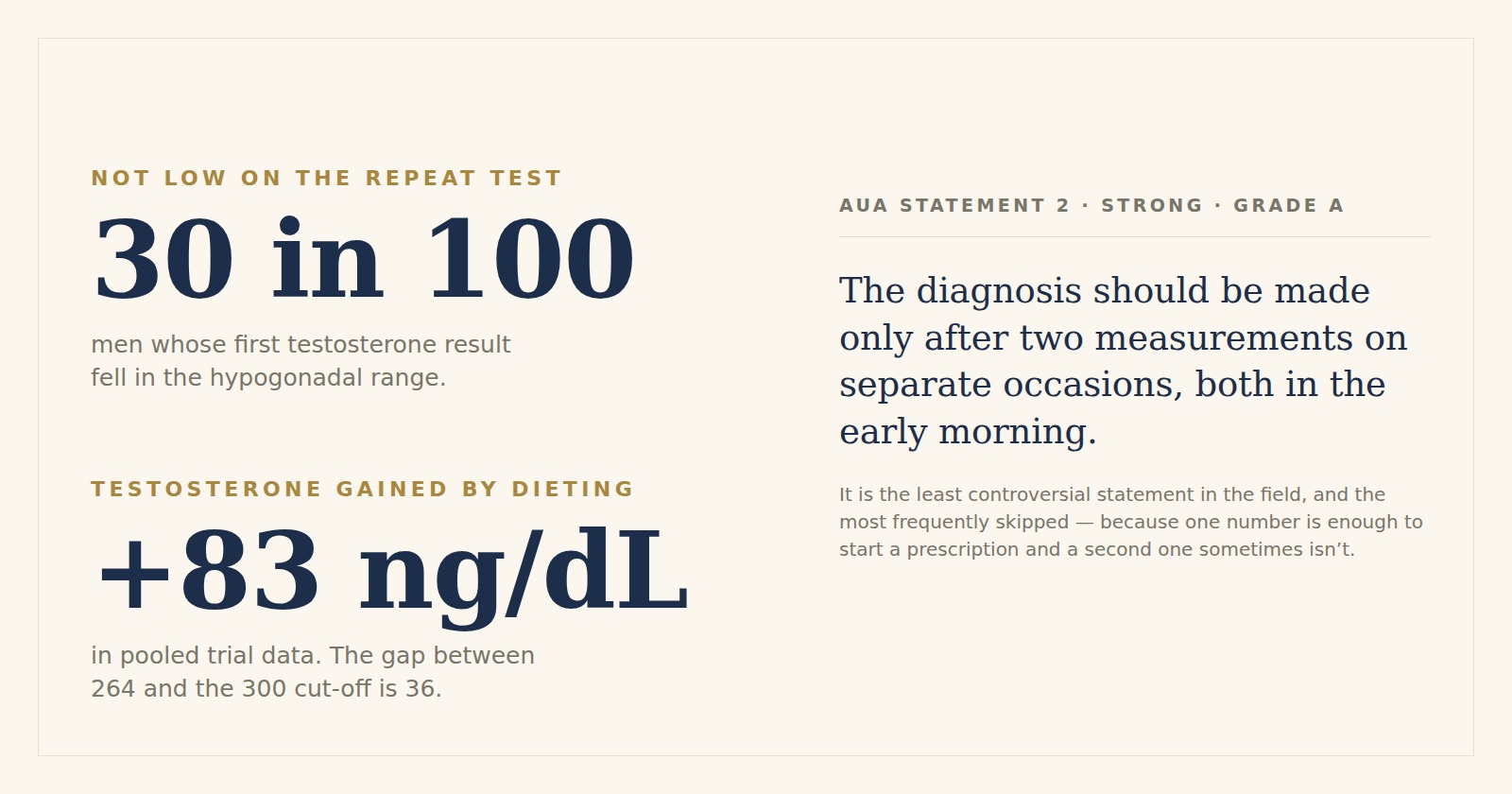
The Endocrine Society's guideline notes that about 30% of men whose first testosterone measurement falls in the hypogonadal range have a normal concentration when the test is repeated. That is before anyone has looked at weight, sleep, medications or anything else. It is simply what happens when you measure a hormone that varies hour to hour and day to day, and then measure it again.
Of the men whose low result is real, a substantial proportion have secondary low testosterone: the testicles are working, and the signal from the brain has been turned down by something. Some of those somethings are correctable, and several of them are correctable by more than the distance between a borderline result and the diagnostic threshold.
This is not an argument against treatment. It is an argument for finding out what you are treating.
Start with the test, not the treatment
Both major guidelines say the same thing. The American Urological Association's Statement 2 — a Strong Recommendation at Grade A, the highest tier it uses — is that the diagnosis should be made only after two total testosterone measurements on separate occasions, both taken in the early morning. The Endocrine Society requires the same, on fasting morning samples.
Two measurements. Not one. Both early. This is the least controversial statement in the entire field and it is also the most frequently skipped, because a single number is enough to start a prescription and a second number sometimes isn't.
If you have been told you have low testosterone on the strength of one blood draw, the correct next step is a second draw, not a prescription. What the numbers mean once you have them is its own subject.
Weight is the biggest lever, and it is quantifiable
This is the one worth putting a number on, because the number is larger than most men expect.
A systematic review and meta-analysis of weight loss trials found that total testosterone rose by roughly 83 ng/dL after low-calorie dieting and roughly 252 ng/dL after bariatric surgery.
Put that against the scale men are actually being judged on. The diagnostic cut-off is 300 ng/dL. A man who measures 264 is 36 ng/dL below it. Diet-induced weight loss moved testosterone by more than twice that distance in the pooled data.
The mechanism is not mysterious. Excess adipose tissue changes the hormonal environment in ways that lower measured testosterone, and reversing the adiposity reverses a good part of it. It is slower than an injection and it addresses the cause rather than the reading.
None of which makes weight loss easy, or a reason to withhold treatment from a man who needs it. It makes it the first thing worth knowing about, particularly since it is the one intervention on this list that improves several other things at the same time.
Sleep, and a distinction that matters
Two different things get discussed as one here, and they behave differently.
Sleep duration. In a controlled study, healthy young men who spent eight nights with five hours in bed had daytime testosterone 10 to 15% lower than in the rested condition. Ten men, so a small study — but a properly controlled one, and the effect size is not trivial. A man being evaluated for low testosterone while sleeping five hours a night is being measured under conditions that lower the result.
Sleep apnea. Obstructive sleep apnea is strongly associated with lower testosterone, and it is badly underdiagnosed. Here is the part that usually gets stated too confidently: a meta-analysis of CPAP trials found no significant change in testosterone with treatment. The most likely explanation is that obesity drives both, so treating the airway without changing the weight does not move the hormone.
The practical version: get sleep apnea diagnosed and treated, because untreated sleep apnea is dangerous on its own terms and because untreated severe apnea is a reason to avoid testosterone therapy. Just do not expect CPAP to raise your testosterone, and be sceptical of anyone who tells you it will.
The medication list is a four-minute conversation
Opioids suppress the axis at the level of the brain, and the reported prevalence of androgen deficiency in men on chronic opioid therapy ranges from 20% to 80% depending on the drug, the dose and how deficiency was defined. That is a wide range and it is uniformly high. If you are on long-term opioids, this belongs at the top of the explanation rather than as a footnote — and the answer is a conversation with the prescriber, not stopping on your own.
Glucocorticoids do the same. The AUA lists chronic corticosteroid use as a reason to measure testosterone even in men with no symptoms.
Acute illness temporarily suppresses testosterone, which is why the Endocrine Society advises against testing men who are unwell or recovering, or who are on short-term medications known to suppress it. If your low result was drawn during a bad month, it may be a measurement of the bad month.
The one nobody volunteers
Past anabolic steroid use is a common and under-disclosed reason for a low testosterone result, particularly in men under 45, and it changes both the diagnosis and the plan.
What is known about recovery after stopping: gonadotropins — the brain's signalling hormones — recover in three to six months in most men. Testosterone recovery is expected but is often incomplete even after months or years, with many men settling in the low-normal range, and a minority never recovering and requiring replacement permanently.
If this is part of your history, say so, including if it was years ago and including if it was brief. It is not a moral conversation. It is a diagnostic one, and withholding it means being evaluated for the wrong condition.
Alcohol
Chronic heavy drinking affects the hormonal axis at several points, and the evidence for it is less well quantified than for weight or sleep. It belongs on the list, and it belongs there honestly: this is a factor worth reviewing rather than a number worth quoting.
What this does not mean
There is a version of this argument that gets used badly, so it is worth drawing the line clearly.
Plenty of low testosterone is real, persistent and structural. Men with genuine hypogonadism — confirmed on repeat testing, with symptoms, and without a reversible explanation — are not helped by being told to sleep more and lose weight for another year. Undertreatment is its own harm, and a man who has done the workup and still has the diagnosis deserves an honest conversation about treatment rather than another lap of lifestyle advice.
The AUA's position accommodates both: Statement 21 is that all men with testosterone deficiency should be counselled on lifestyle modification as a treatment strategy. As a treatment strategy — alongside the diagnosis, not instead of making one.
The distinction that matters is between a workup that looks for a reversible cause and finds none, and a workup that was never done. Both end in a prescription for some men. Only one of them knows why.
The order worth doing this in
- Repeat the test properly. Two early-morning draws on separate days. Three men in ten will not need anything past this step.
- Review the medication list and the history — opioids, glucocorticoids, past anabolic steroid use, alcohol, recent illness. This costs nothing and takes minutes.
- Establish whether this is primary or secondary, which means LH and FSH, and prolactin if testosterone is low with a low or low-normal LH. That distinction changes everything downstream, including whether imaging is needed.
- Screen for sleep apnea if there is any suggestion of it, for its own sake and because it affects whether therapy is appropriate.
- Address weight if it is a factor, knowing the realistic magnitude and that it is measured in months.
- Then have the treatment conversation, on a foundation of knowing what is being treated. What that involves is covered in the piece on evaluation and in what monitoring looks like afterwards.
The whole sequence is a history, a medication list and a handful of blood tests — which is what requiring labs before treatment is actually for.
When this needs more than a workup
- Very low testosterone with a low or low-normal LH, which needs prolactin measured and may need pituitary imaging
- Headaches or changes in vision alongside low testosterone, which are pituitary red flags and should not wait
- Breast tissue development or breast tenderness
- Loss of body or facial hair, or shrinking testicles
- Difficulty conceiving, which changes the entire treatment approach and should be raised before anything is prescribed
- Low testosterone alongside unexplained anemia, bone density loss or a history of testicular injury, radiation or chemotherapy
Where I land
The gap between a careful evaluation and a fast one is not sophistication. It is a second blood draw, a medication list and an honest history — perhaps twenty minutes in total, spread over two weeks.
Three men in ten will not have low testosterone at the end of it. Some of the rest will find a reason that can be addressed. And the men who complete that process and still have the diagnosis will start treatment knowing what it is for, which is a materially better position than starting it because a number came back low on a Tuesday.
Frequently asked questions
Can low testosterone go back to normal on its own?
Often, yes. The Endocrine Society's guideline notes that about 30% of men whose first testosterone measurement falls in the hypogonadal range have a normal concentration when the measurement is repeated, because testosterone varies substantially hour to hour and day to day. Beyond that, low testosterone that is secondary to weight, short sleep, medications, alcohol or recent illness can improve when the contributor is addressed.
How much does weight loss raise testosterone?
A meta-analysis of weight loss trials found total testosterone rose by roughly 83 ng/dL with low-calorie dieting and roughly 252 ng/dL after bariatric surgery. For scale, the usual diagnostic cut-off is 300 ng/dL, so a man measuring 264 is 36 ng/dL below it — meaningfully less than the average effect of dieting in those trials.
Does sleep affect testosterone?
Yes, and measurably. In a controlled study, healthy young men who spent eight nights with five hours in bed had daytime testosterone 10 to 15% lower than when rested. It was a small study of ten men, but a well-controlled one, and it means a man evaluated while chronically short of sleep is being measured under conditions that lower the result.
Will treating sleep apnea raise my testosterone?
Probably not directly. Obstructive sleep apnea is strongly associated with lower testosterone, but a meta-analysis of CPAP trials found no significant change in testosterone with treatment — most likely because obesity drives both. Sleep apnea should be diagnosed and treated because untreated apnea is harmful in itself, and because untreated severe apnea is a reason to avoid testosterone therapy. It is not a testosterone strategy.
Do I need to tell my doctor about past steroid use?
Yes, including if it was brief and including if it was years ago. Past anabolic steroid use is a common reason for low testosterone in younger men and it changes both the diagnosis and the plan. Gonadotropins usually recover within three to six months of stopping, but testosterone recovery is frequently incomplete, and some men do not recover at all. Not disclosing it means being evaluated for a different condition than the one you have.
Should I fix these things before starting testosterone therapy?
Where a reversible contributor exists, it is worth addressing, and the AUA recommends that all men with testosterone deficiency be counselled on lifestyle modification as a treatment strategy. But a man with confirmed hypogonadism, symptoms, and no reversible explanation should not be sent away for another year of lifestyle advice — undertreatment is its own harm. The point of the workup is to know which situation you are in.
Before you go
If you have a single low number and a prescription waiting on it, the useful question is not whether testosterone therapy works. It is whether anyone has established that you need it.
This article is for general education and is not medical advice for any individual. It doesn't establish a physician-patient relationship. Talk to a licensed clinician about your own situation.