
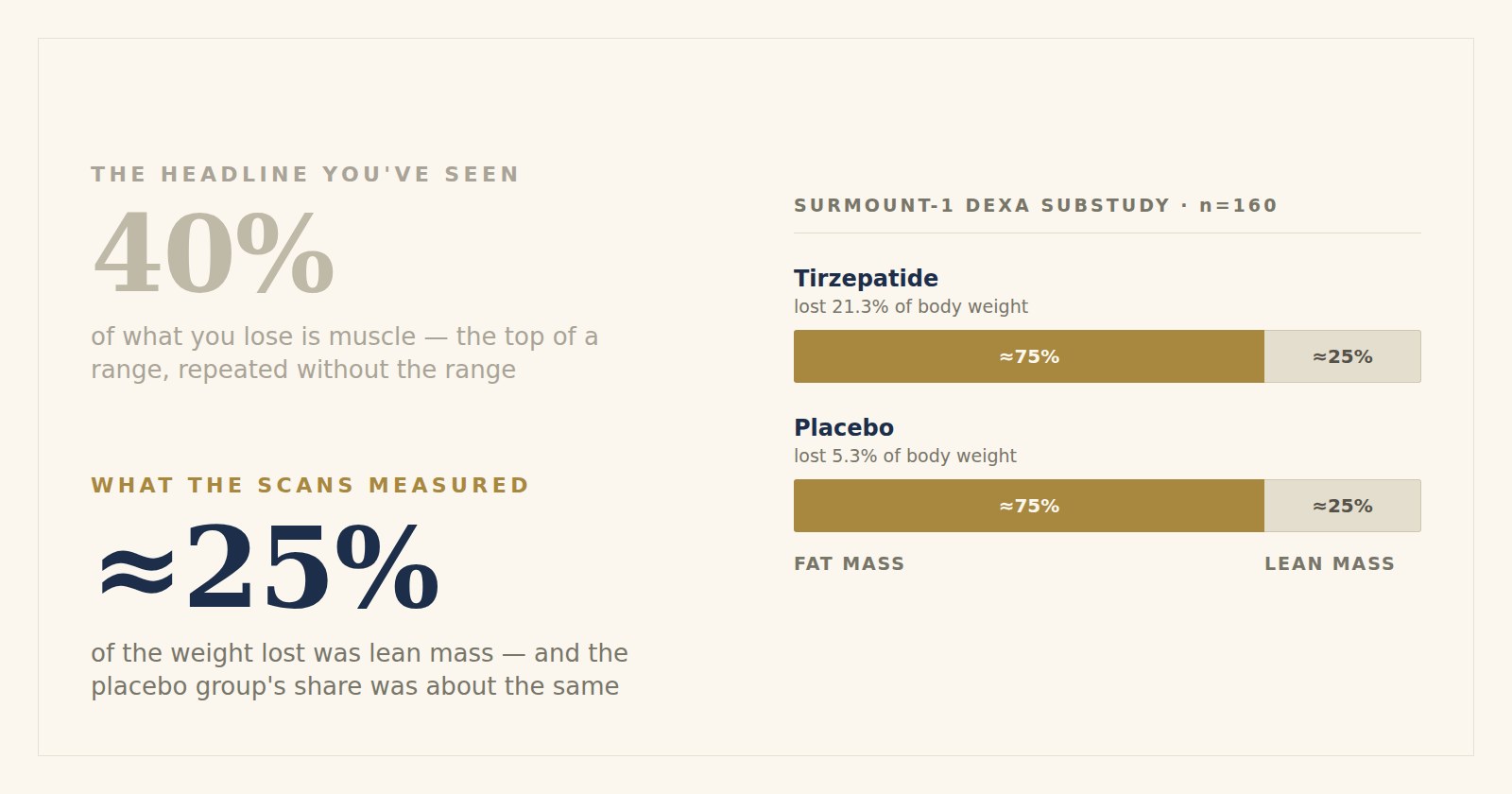

Somebody sends me a video about this almost every week. The headline is usually some version of forty percent of the weight you lose on these drugs is muscle, delivered by a person with visible abdominal muscles and no citation.
I understand why it lands. It's scary, it sounds specific, and it arrives right when you're feeling good about the scale finally moving. The question deserves to be taken seriously — so let's look at what the studies actually measured.
The short answer
Yes, some lean mass comes off when you lose weight on a GLP-1 medication. In the trials that measured it, roughly a quarter of the weight lost was lean mass and roughly three quarters was fat.
Here's the part that never makes it into the video: in the same trial, the people who got a placebo and lost weight the ordinary way lost lean mass in approximately the same proportion. Losing lean tissue isn't a side effect of the medication. It's what happens when a human body gets smaller.
What you do while you're losing — protein, resistance training, how fast you drop weight, whether you eat enough at all — has more to do with how much you keep than which method got you into a calorie deficit.
That's the answer. Now the details, because the details are where people get misled.
"Lean mass" and "muscle" are not the same word
This is the single biggest source of confusion, so it's worth thirty seconds.
Body composition scans sort your body into fat mass and fat-free mass, sometimes called lean mass. Fat-free mass is everything that isn't fat: skeletal muscle, yes, but also organs, bone, connective tissue, blood, glycogen, and the water that travels with all of it.
When a person loses fifty pounds of fat, other tissue comes with it, and some of that is appropriate. The connective tissue that held the fat, the blood volume that perfused it, the larger heart and kidneys that supported a larger body — those scale down too. A scan reports all of it as "lean mass loss." It doesn't mean your quadriceps evaporated. So when a study reports a 10% drop in lean mass, the number is real, but it isn't a muscle-biopsy number.
What the body composition studies actually found
Two of the big obesity trials ran imaging substudies. These are the numbers being argued about.
Tirzepatide, SURMOUNT-1. A substudy of 160 participants had DEXA scans at baseline and week 72 (Look and colleagues, Diabetes, Obesity and Metabolism, 2025). On tirzepatide, body weight fell 21.3%, fat mass 33.9%, lean mass 10.9%. On placebo, the same three numbers were 5.3%, 8.2%, and 2.6%. The authors' summary: of the body weight lost, approximately 75% was fat mass and 25% was lean mass — for both tirzepatide and placebo. That proportion held across sexes, across age groups including participants 65 and older, and across how much total weight people lost.
Semaglutide, STEP 1. An exploratory analysis of 140 participants (Wilding and colleagues, Journal of the Endocrine Society, 2021) found total fat mass down 19.3% and visceral fat down 27.4% at week 68. Absolute lean mass fell 9.7% — but because fat fell faster, lean mass as a share of the body rose about 3 percentage points, and the lean-to-fat ratio improved from 1.34 to 1.57.
That last point is the one I'd underline. Absolute lean mass went down. The mix got better.
So where does "forty percent" come from? Most likely a 2024 perspective piece in The Lancet Diabetes & Endocrinology by Prado and colleagues, noting that fat-free mass loss can account for 25% to 39% of total weight lost across studies running 36 to 72 weeks. The top of a range became a headline. That paper's argument was never "don't take these medications" — it was that muscle deserves attention during any medically supervised weight loss. I agree completely.
How this compares to losing weight other ways
A 2026 systematic review in Diabetes, Obesity and Metabolism (Busk-Cirera and colleagues) pooled 21 studies and 1,334 people, and sorted the proportion of weight lost as fat-free mass by method:
How to read this table, because it is easy to read it wrong. The incretin figure is placebo-subtracted — it reports the change versus placebo, with the placebo group's own fat-free mass loss taken out — while the diet and surgery figures are within-group changes. Those are two different quantities, and lining them up in one column does not make them comparable. The 1.8 kg figure belongs to the pooled diet category (14.9%), not to either subgroup on its own. The review also included only studies in which participants lost at least 10% of body weight, so none of these rows describes what happens across the full range of weight loss.
That table has two honest readings, and you need both.
The uncomfortable one: the medication row is higher than the diet rows, and I won't pretend that's nothing. Some of it is arithmetic — bigger total weight loss means more absolute lean mass loss. But how much of the rest is real is not something this table can tell you, because the medication figure is calculated one way and the surgery figure another, and because these were separate studies pooled across trials rather than a head-to-head experiment. That's precisely why the within-trial SURMOUNT-1 comparison — the same trial, medication versus placebo, approximately the same lean-mass share in both — deserves more weight here than a cross-study column.
The reassuring one: look at the two diet subgroups. Losing weight with structured exercise versus without is the difference between 7.7% and 22.3%. That's a large contrast, and it points the same direction as everything else in this post. But it carries the same caveat as the medication row: these were separate studies pooled, not the same people randomized to exercise or not, so read it as a strong signal about what exercise does rather than as a measured effect you can bank on individually. The authors' conclusion wasn't "avoid these medications." It was that exercise belongs in every weight-loss approach. Mine too.
Mass is what we measure. Function is what you live in.
Muscle mass is a proxy. What matters is whether you can carry groceries up stairs at 70, get off the floor, catch yourself when you trip.
A 12-month prospective study of 106 patients on semaglutide (the SEMALEAN study, Alissou and colleagues, Diabetes, Obesity and Metabolism, 2026) tracked both. Weight fell 12.7% and fat mass 18.9%. Lean mass dropped about 3 kg over the first seven months, then stabilized. Handgrip strength — a standard measure of muscle function — went up, by about 4 kg. The share meeting criteria for sarcopenic obesity fell from 49% to 33%.
That's one observational study, not a randomized trial, and I hold it loosely. But it fits what I see clinically: people who lose a meaningful amount of weight tend to move more, not less, and function often improves even while a scan shows less lean tissue. The Prado paper was candid that the short-term effects on strength remain unclear. That's the honest state of the science.
Who should take this more seriously
For someone who is otherwise healthy, training regularly, and eating adequate protein, this is a plan-it-and-move-on item. There are people for whom I weight it much more heavily:
- Adults over about 65. Muscle and strength already decline with age. Starting from less means less margin.
- Women in and after menopause. Falling estrogen accelerates loss of both muscle and bone. Losing weight in that window without a strength plan is a missed opportunity at best.
- Anyone already low on muscle — sarcopenia, sarcopenic obesity, long illness, immobility, or a history of very restrictive dieting.
- People with a lower starting BMI who don't have a large fat reserve to draw down.
- Anyone whose intake has collapsed. If nausea or early fullness has you eating 800 calories a day and no protein, the intake is the problem — call your physician about dose, timing, or symptom management rather than white-knuckling it.
None of those are reasons not to treat. They're reasons to treat with a plan, said out loud at the first visit.
What actually reduces it
Four things, in roughly this order of impact.
1. Load your muscles. Resistance training has the best evidence, and it isn't optional if muscle is your concern. A 2022 review in Obesity Reviews pooling 114 randomized trials and over 4,000 participants found resistance training plus caloric restriction was the most effective approach for reducing body fat, with resistance training also driving gains in lean mass. Two or three sessions a week covering the major movement patterns — push, pull, squat or hinge, carry — is a reasonable general target. Bands and body weight at home count. Consistency beats sophistication. And the same caution applies here as to the protein numbers below: what's appropriate for you — given your joints, your cardiac history, and where you're starting from — is a conversation with a clinician, not something you take off a blog.
And you don't have to take my word for the combination. In a 2021 New England Journal of Medicine trial, Lundgren and colleagues tested exercise, liraglutide 3.0 mg daily, both, or neither after an initial diet. The combination cut body fat percentage by 3.9 points — roughly twice what either did alone. Worth naming the drug plainly: liraglutide is a GLP-1 medication, but it is a different agent from semaglutide and tirzepatide and it is injected daily rather than weekly, so this trial is evidence about the combination of exercise and a GLP-1, not a study of the medications this post is otherwise about.
2. Eat enough protein. The most-cited target for preserving lean mass during caloric restriction is about 1.2 to 1.6 grams per kilogram of body weight per day, spread across meals at roughly 25 to 30 grams a sitting (Leidy and colleagues, American Journal of Clinical Nutrition, 2015). In a pooled analysis of 24 energy-restricted randomized trials cited in that review, higher-protein diets preserved about 0.43 kg more lean mass than lower-protein diets (Wycherley and colleagues, American Journal of Clinical Nutrition, 2012). For adults over 65, the ESPEN expert group recommends at least 1.0–1.2 g/kg/day at baseline, more with illness.
Two caveats I'd rather you hear from me than discover later. Those targets come from diet-induced weight loss studies, not GLP-1 trials — the first randomized trial testing resistance exercise and a 1.6 g/kg protein target during semaglutide and tirzepatide therapy (LEAN-PREP) only began recruiting in 2025. And the right number for your body weight and kidney function is a conversation with a clinician, not something you take off a blog.
The practical problem on a GLP-1 isn't knowing the target. It's hitting it when you aren't hungry — which deserves its own post, and is what I coach most often.
3. Don't lose faster than you need to. A meta-analysis of gradual versus rapid weight loss (Ashtary-Larky and colleagues, British Journal of Nutrition, 2020) found gradual loss produced greater fat mass reduction and better preserved resting metabolic rate. In fairness, the fat-free mass difference in that analysis wasn't statistically significant — so the case for a moderate pace is strong on metabolic grounds and suggestive on muscle grounds. It's also why we titrate doses slowly instead of chasing the fastest possible number.
4. Eat enough, period. Very low intake plus no protein plus no training is what costs you muscle, on any weight loss method ever invented. If appetite suppression has pushed you well below what your body needs, that's a dose and symptom-management conversation.
Where creatine fits
Creatine monohydrate is among the most-studied supplements in existence and reasonable to discuss — but let me be precise about what the evidence supports.
In older adults doing resistance training, a meta-analysis of 22 trials and 721 participants (Chilibeck and colleagues, Open Access Journal of Sports Medicine, 2017) found creatine added about 1.37 kg of lean tissue mass over placebo, plus small strength gains. A 2025 meta-analysis found a smaller but still positive effect. A 2025 trial in Nutrients found that after an initial 7-day loading effect, creatine added nothing beyond what 12 weeks of resistance training delivered alone.
Notice the common thread: creatine plus training. There's no good evidence it does much without the training, and no completed trials of creatine specifically during GLP-1 therapy. It's a supplement, not a treatment, and whether it's appropriate for you — particularly with kidney disease — is a physician question.
The other side of the ledger
While we're being straight with each other: these medications carry real risks. Gastrointestinal side effects are common — in the labeling for the FDA-approved semaglutide product for weight management, nausea was reported in 44% of patients, diarrhea 30%, vomiting 24%, constipation 24%. There is a boxed warning for thyroid C-cell tumors based on rodent studies, and the approved products are contraindicated in people with a personal or family history of medullary thyroid carcinoma or MEN 2. Pancreatitis and gallbladder disease are recognized warnings.
And because we prescribe compounded formulations at Billie Jean Health: compounded medications are not FDA-approved products, and the FDA does not review compounded drugs for safety, effectiveness, or quality before they are marketed. That's the FDA's own language, and I'd rather you read it here than be surprised later.
Frequently asked questions
Do GLP-1s cause muscle loss?
They cause weight loss, and weight loss includes some lean mass. In the SURMOUNT-1 body composition substudy, about 25% of the weight lost was lean mass — approximately the same proportion as in the placebo group.
How much protein should I eat on a GLP-1?
Research on preserving lean mass during caloric restriction generally supports about 1.2–1.6 g per kg of body weight daily, in 25–30 g portions. Those figures come from diet studies rather than GLP-1 trials, and your target should be set with a clinician.
Will lifting weights prevent it entirely?
No, and I'd be suspicious of anyone who says otherwise. But it's the largest lever in the data.
Should I get a DEXA scan?
A baseline scan and a repeat some months in is a reasonable way to see fat and lean mass separately instead of guessing from the scale. It isn't necessary for everyone — simpler markers, like whether your strength numbers are holding, tell you a lot.
Is one medication better than the other for muscle?
The head-to-head evidence isn't there. Side effect profile, tolerability, and your medical history matter more.
If you're weighing this
The version of this that worries me isn't the person asking the question. It's the person who reads a scary headline, quietly stops treatment, and regains the weight without ever having had the conversation.
Muscle loss during weight loss is real, measurable, and largely manageable — with protein, resistance training, a sane pace, and someone paying attention the whole way. That last part is why I built this practice the way I did. My patients hear me say it constantly: you are never bothering me.
Whether a GLP-1 medication is appropriate for you at all takes a physician who knows your history and your labs. This isn't right for everyone, and results vary. But if you've been putting the conversation off because of something you saw on your phone, that's exactly what an initial visit is for.
Ozempic® and Wegovy® are registered trademarks of Novo Nordisk. Mounjaro® and Zepbound® are registered trademarks of Eli Lilly and Company. Billie Jean Health is not affiliated with, endorsed by, or sponsored by either company.
This article is for general education and is not medical advice for any individual. It doesn't establish a physician-patient relationship. Talk to a licensed clinician about your own situation.