

It comes near the end of the visit, usually after we've covered dosing and side effects and what the first month looks like. The patient pauses, and then: Am I going to be on this forever?
It's the most common question I get, and it isn't really a pharmacology question. Underneath it is something more like: is this something I'm doing, or something I've become? Some people ask because they don't want a permanent prescription. Some ask because they're afraid the day they stop is the day it all comes back.
Both are fair. Here's the straight answer, including the parts less comfortable than a marketing page would like.
The short answer
For many people, treating obesity is a long-term project, and the medication is often part of that long term. When people stop a GLP-1 medication without another plan in place, the research consistently shows substantial weight regain — on average, most of what was lost.
But "many people" isn't "everyone," and "most of what was lost" isn't "all of it." Some people do come off, hold their loss, and don't come back. Others stay on a reduced dose for years. Others cycle. What I won't do is tell you at your first visit which of those you'll be, because I don't know — and neither does anybody promising you otherwise.
What I can do is show you the numbers and make sure the decision is yours.
What actually happens when people stop
Three trials answer this most directly, and they agree.
STEP 1 extension. Participants on semaglutide lost an average of 17.3% of body weight over 68 weeks. Then treatment stopped. One year later — week 120 — they had regained an average of 11.6 percentage points, leaving them about 5.6% below baseline. Roughly two-thirds of the loss came back. About 48% were still holding at least a 5% reduction. Most blood pressure and metabolic improvements drifted back toward baseline (Wilding and colleagues, Diabetes, Obesity and Metabolism, 2022).
SURMOUNT-4. Participants took tirzepatide openly for 36 weeks and lost an average of 20.9%. Then half were switched to placebo. Over the next 52 weeks, the group that continued lost another 5.5%; the placebo group gained 14.0% back. Total reduction from baseline at the end: 25.3% for those who continued, 9.9% for those who stopped (Aronne and colleagues, JAMA, 2024).
STEP 4. Same design, different drug. After a 20-week run-in, continuing semaglutide produced a further 7.9% loss over the next 48 weeks; switching to placebo produced a 6.9% gain (Rubino and colleagues, JAMA, 2021).
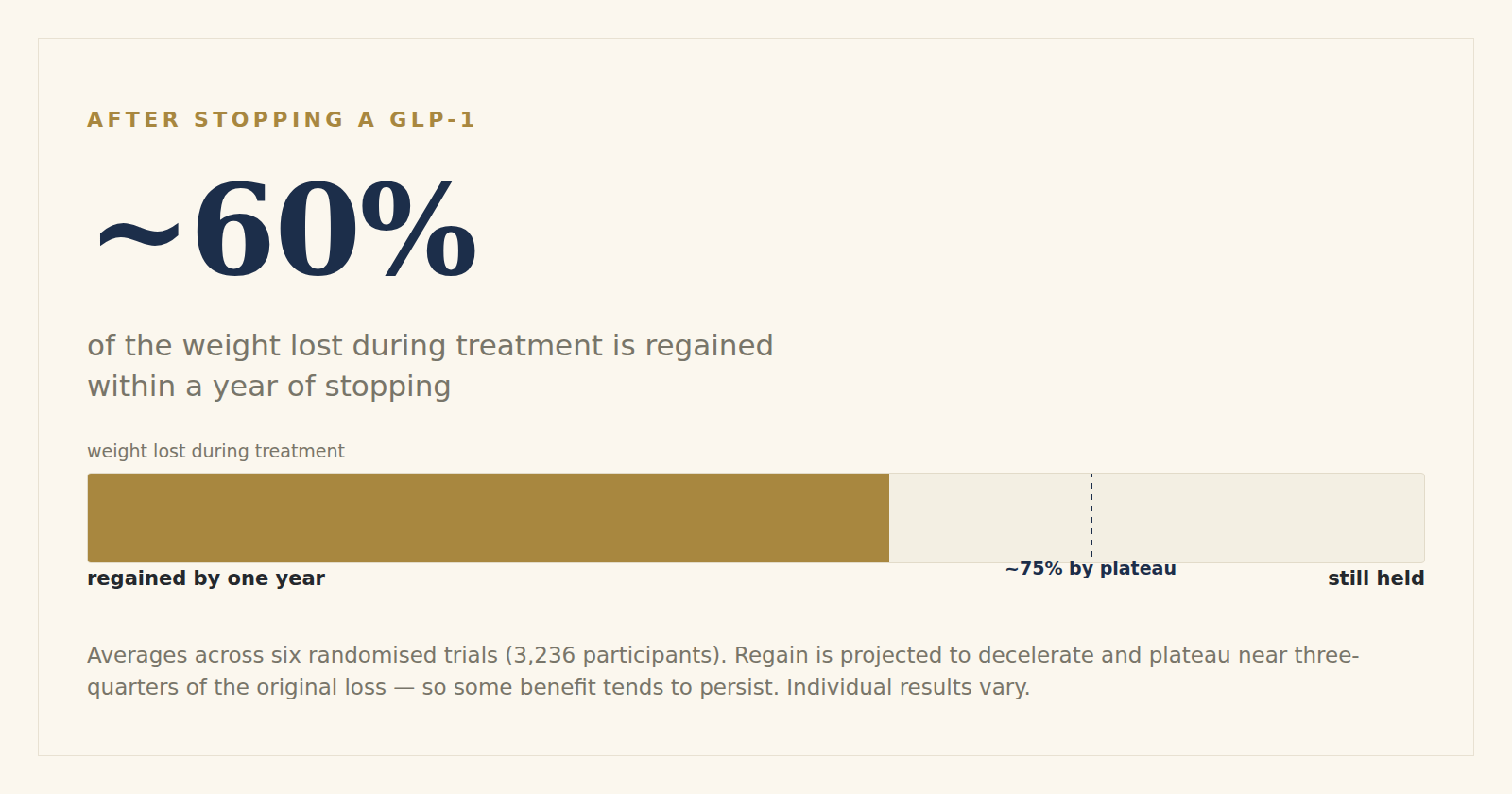
And the big-picture version: a 2026 systematic review and meta-regression in eClinicalMedicine reviewed 48 studies, and modeled the shape of regain from 6 randomized controlled trials covering 3,236 participants. At one year after stopping, an average of 60% of the weight lost during treatment had been regained. The model projected that regain decelerates and plateaus at roughly three-quarters of the original loss — meaning some benefit tends to persist long-term, but substantially less than what treatment produced (Budini and colleagues, 2026).
I want you to sit with that last sentence, because it cuts both ways. Stopping is not a cliff back to where you started. It's also not a plateau at your goal weight.
Why this isn't a failure of willpower
Your body actively defends a weight it has learned to consider normal. Lose a meaningful amount, and appetite hormones shift toward hunger, satiety signals soften, and resting energy expenditure falls somewhat below what your new size would predict. These changes persist. They aren't a character issue. They're physiology — and they're why "eat less, move more," delivered as advice, has such a poor long-term track record. Not because it's wrong, but because it asks you to out-argue a system that's arguing back.
A GLP-1 medication works partly by turning down that argument. Take it away and the biology returns, largely unchanged. Which is exactly what the trials above show.
This is why the American Medical Association, in 2013, adopted policy recognizing obesity as a disease state with multiple pathophysiological aspects requiring a range of interventions. It's why the Endocrine Society's clinical practice guideline treats obesity pharmacotherapy as chronic-disease management. And in January 2026, the Obesity Association — a division of the American Diabetes Association — published standards of care recommending that FDA-approved obesity medications (with the exception of phentermine) be used long-term, including after weight goals are reached.
The question we don't ask about other medications
I've never had a patient finish a blood pressure discussion by asking whether they'll be on lisinopril forever. Nobody asks it about levothyroxine or a statin. We understand those as ongoing management of a condition that hasn't gone away — the medication works, and when you stop, the number goes back up.
Obesity gets asked differently, and it's worth naming why. There's an old assumption underneath it: that body weight is a moral outcome rather than a medical one, and that needing help means you didn't try hard enough. I don't hold that view, and the physiology doesn't support it.
That said — the analogy is a rhetorical device and it isn't perfect. These medications are newer than the ones I listed. The longest randomized safety data runs a few years, not decades. Side effects can be limiting. Cost is real, and for cash-pay care it's often the deciding factor. I use the comparison to reframe the shame, not to close the argument.
For some people, it isn't forever - and I won't pretend otherwise
There are patients who reach their goal, spend a stretch of time building durably different habits — training consistently, eating differently, sleeping better — taper off, and hold it. The discontinuation trials report averages, and averages contain people who did much better than the mean. In the STEP 1 extension, nearly half were still holding a 5% or greater reduction a full year after stopping.
There's also a real difference between someone who's used the treatment window to build a strength habit and someone who's changed nothing but appetite.
The most striking evidence on that point comes from a Danish trial. After an initial diet, participants spent a year on supervised exercise, liraglutide 3.0 mg daily, both, or neither — then everything stopped and they were followed for another year. Weight regain was 6.0 kg greater after stopping the medication than after stopping supervised exercise, and the group that had done both was still 5.1 kg lighter than the medication-alone group a year later (Jensen and colleagues, eClinicalMedicine, 2024, reporting the follow-up to Lundgren and colleagues, NEJM, 2021). Worth being precise about the drug: liraglutide is a GLP-1 medication, but it is a different agent from semaglutide and tirzepatide and it is injected daily rather than weekly. The lesson about what exercise leaves behind travels; the specific numbers come from a trial of a different medication.
That is one of the most useful findings in this literature: what you build during treatment keeps paying after treatment ends. The medication doesn't. It's an argument for using the window well, not for skipping the medication.
What "off-ramping" thoughtfully looks like
If and when coming off is on the table, it should be a plan, not an event. The Obesity Association's 2026 standards lay out the realistic options: continuing at the lowest effective dose (which may not be an approved maintenance dose), intermittent therapy, switching to a different agent, or stopping with close monitoring.
In practice, a thoughtful taper tends to involve a few things:
- Getting to a genuine plateau first. Coming off in the middle of active loss is coming off while your body is at its most defensive.
- Stepping down, not off. Reducing dose while watching what happens for a couple of months tells you far more than an abrupt stop.
- Having the non-drug scaffolding already in place — resistance training two or three times a week, protein you actually hit, sleep, alcohol — before the taper, not as a plan to start after.
- Defining a trigger to reassess. A specific number, agreed in advance, at which we talk again. Not "we'll see how it goes."
- Keeping the follow-up. The 2026 standards suggest monthly check-ins in the first three months of any change, then quarterly in the first year, then every six months. Telehealth is explicitly acceptable for this.
One caveat those standards acknowledge themselves: the optimal tapering schedule hasn't been established by trials, and we don't have reliable predictors of who maintains after stopping. Anyone claiming a proven protocol is ahead of the evidence.
What makes maintaining easier
Drawn from the research above and from what I watch play out clinically:
- Resistance training. It's the single item with the best evidence for what happens after treatment stops.
- Protein at every meal. Satiety and lean mass both.
- A weight you can actually live at, rather than the lowest number you briefly touched. Defending an unsustainable low is a losing fight.
- Monitoring that doesn't stop when the prescription does. Regain is far easier to address at eight pounds than at forty.
- A physician you'll actually message. I tell every patient this and I mean it: you are never bothering me. The people who do best reach out early, rather than disappearing for a year and coming back apologizing.
Frequently asked questions
Do you have to take semaglutide or tirzepatide forever?
Not necessarily, but the evidence points toward long-term treatment for many people. Major clinical guidance, including the Obesity Association's 2026 standards of care, recommends long-term use of FDA-approved obesity medications even after weight goals are met. Whether that applies to you is an individual clinical decision.
How much weight do people regain after stopping a GLP-1?
In a 2026 systematic review of 48 studies, whose meta-regression modeled 6 randomized controlled trials and 3,236 participants, an average of about 60% of the weight lost was regained by one year after stopping, with the model projecting a plateau near three-quarters of the original loss. Individual results vary considerably.
Can I go to a lower dose instead of stopping?
A lower maintenance dose is one of the recognized options, alongside intermittent therapy, switching agents, or stopping with monitoring. There is less trial evidence for maintenance-dose strategies than for continuing at the studied dose, so this is a judgment call a physician makes with you.
Is it bad to stop and restart?
Cycling isn't ideal — repeated loss and regain has its own downsides — but it isn't a catastrophe or a reason not to start. Life circumstances change. Have that conversation with your physician rather than deciding alone.
Does the medication stop working over time?
The trials don't show loss of effect; SURMOUNT-4 participants who continued kept losing during the maintenance year. Weight loss does plateau as the body reaches a new equilibrium, which is different from the medication failing.
What if I stop because of side effects or cost?
Both are common and legitimate reasons, and there are other approaches — different agent, different dose, different strategy. The wrong move is disappearing without telling anyone.
Where I land on it
If I could give one answer to the whole question, it would be this: you're not signing a life sentence, and you're also not buying a temporary fix. You're starting the treatment of a chronic condition, which means the plan gets revisited — with real data, by a physician who knows your history — rather than decided once at the beginning.
Some patients stay on. Some step down. Some stop entirely and do well. What all three groups have in common is that somebody was paying attention the whole way.
A few things I'm obligated to say plainly, and would say anyway. These medications aren't right for everyone; there are conditions and histories that rule them out, and screening for those is part of what a first visit is for. They carry real risks, including common gastrointestinal side effects and a boxed warning for thyroid C-cell tumors on the FDA-approved products, which are contraindicated in people with a personal or family history of medullary thyroid carcinoma or MEN 2. Results in clinical trials are averages, and results vary. And the compounded formulations we work with at Billie Jean Health are not FDA-approved products — the FDA does not review compounded drugs for safety, effectiveness, or quality before they are marketed.
If you're earlier in the process than that, our companion pieces cover how semaglutide and tirzepatide work and how their side effects differ.
If you're weighing whether to start, or you're already on treatment and quietly wondering how this ends, that's not a question for a search engine. It's the conversation to have with a physician who will still be there in two years to have it again.
Ozempic® and Wegovy® are registered trademarks of Novo Nordisk. Mounjaro® and Zepbound® are registered trademarks of Eli Lilly and Company. Billie Jean Health is not affiliated with, endorsed by, or sponsored by either company.
This article is for general education and is not medical advice for any individual. It doesn't establish a physician-patient relationship. Talk to a licensed clinician about your own situation.