

Last reviewed: September 2026
The short version
There is one menopause symptom that behaves differently from all the others, and almost nobody is told which one it is.
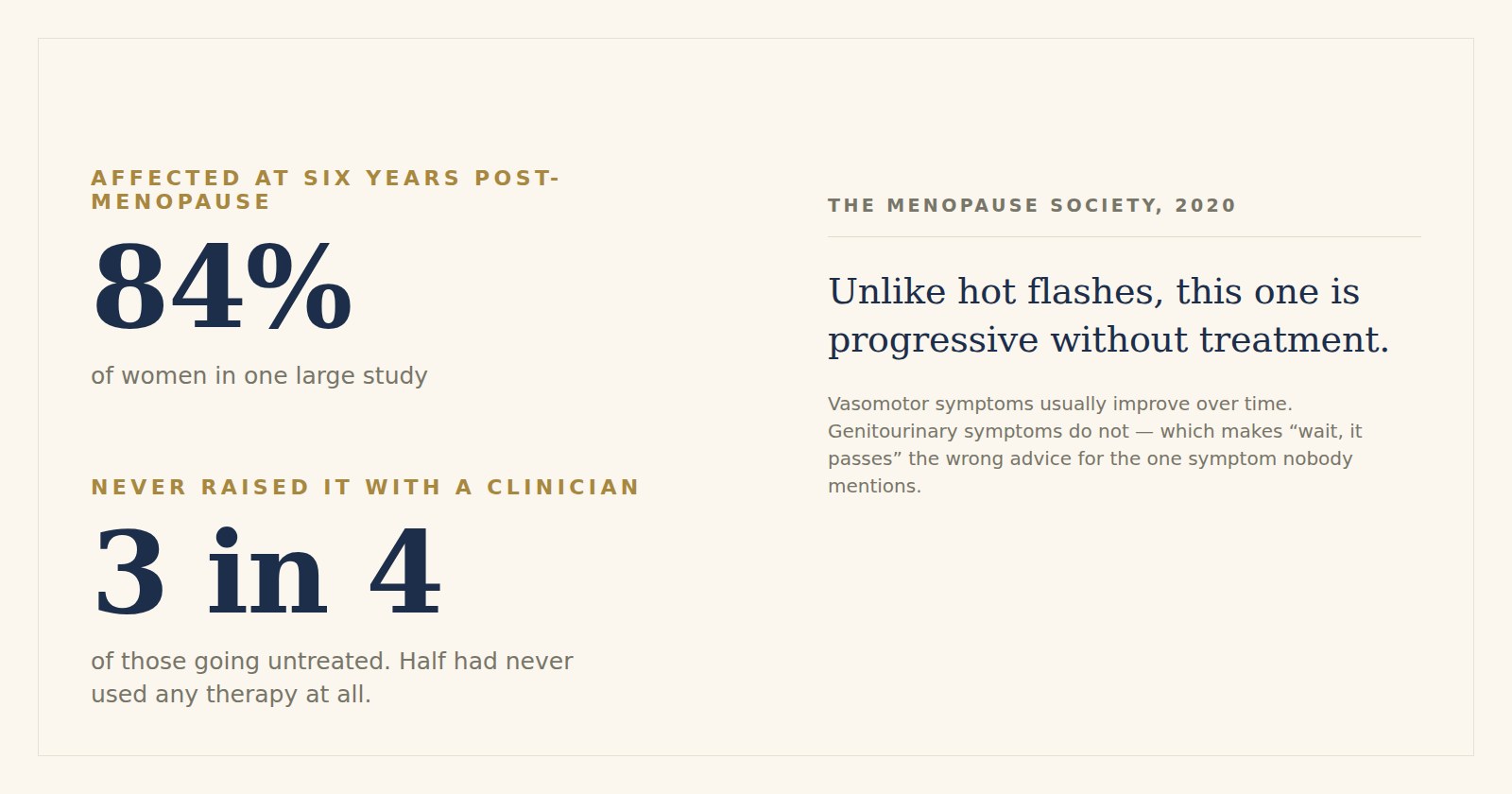
Hot flashes and night sweats are miserable, and they improve with time. The genitourinary symptoms — vaginal dryness, burning, discomfort with sex, urinary urgency and recurrent urinary tract infections — do not. The North American Menopause Society puts it plainly: in contrast to vasomotor symptoms, which usually improve over time, this is generally progressive without effective therapy.
So the advice that quietly works for hot flashes — wait, it passes — is exactly wrong here. Waiting does not help. It is the one thing that reliably makes it worse.
It affects somewhere between 27% and 84% of postmenopausal women depending on how and when you measure; in one large study, 84% of women six years past menopause. And it is treated far less than that. In a survey of 1,858 postmenopausal women with genitourinary symptoms, half had never used any therapy at all, and among the untreated, almost three-quarters had never discussed it with a healthcare provider.
That last number is the real problem. This is not mainly a treatment failure. It is a conversation that does not happen.
What it actually is
The name changed for a reason. It used to be called vulvovaginal atrophy, which described only part of it and sounded like a verdict. Genitourinary syndrome of menopause is broader and more accurate, because the tissue affected is not only vaginal.
Estrogen receptors are present throughout the vulva, vagina, urethra and bladder base. When estrogen falls, those tissues become thinner, less elastic and less well lubricated, the local pH rises, and the resident bacterial population shifts. The consequences show up in more than one place:
- Vaginal — dryness, burning, irritation, discharge changes, discomfort or pain with penetration, and bleeding after sex from fragile tissue.
- Vulvar — soreness, itching, sensitivity to friction from clothing or exercise.
- Urinary — urgency, frequency, discomfort passing urine, and recurrent urinary tract infections. This is the part most often attributed to something else entirely.
These sit alongside the hot flashes, sleep disruption and mood changes covered in signs of hormone imbalance in women — but unlike those, this group does not settle down on its own.
The urinary piece deserves its own section, because it is the part most often missed.
The recurrent UTI connection
Recurrent urinary tract infections in a postmenopausal woman are frequently managed as an infection problem — one course of antibiotics at a time, then another a few months later, then a discussion about prophylactic antibiotics.
What that approach does not address is why the infections keep happening. As estrogen falls, the vaginal pH rises and the resident bacterial population shifts away from the lactobacilli that normally keep it acidic, which makes colonisation by urinary pathogens easier. The tissue of the urethra thins at the same time. Antibiotics treat each episode and change none of that.
So if recurrent UTIs are part of your picture, it is worth asking whether the genitourinary changes of menopause are contributing — because that reframes the problem from an infection you keep catching to a tissue change that keeps making infection likely, and those have different treatments.
Why nobody brings it up
Three-quarters of untreated women never mention it, and the reasons are not mysterious.
It is embarrassing to raise. It is easy to assume it is simply what ageing is, and that there is nothing to be done. Appointments are short and there is usually something else on the agenda. And a great many women have had the experience of raising it once, receiving a lubricant recommendation and nothing else, and concluding that this is the whole of what medicine has to offer.
The other half of the failure sits on the clinician's side of the desk. If nobody asks, most people will not volunteer, and this is a symptom that requires asking about directly.
If you have been waiting for a natural opening in a conversation, there isn't one. It is entirely reasonable to open an appointment with it.
What to actually say
If the difficulty is the opening sentence rather than the willingness, any of these does the job, and none requires detail you would rather not give:
- “I want to ask about vaginal dryness — it's been getting worse rather than better.”
- “Sex has become uncomfortable and I'd like to know what the options are.”
- “I keep getting urinary infections and I've read that menopause might be part of why.”
- “I read about genitourinary syndrome of menopause and I think it describes me.”
A clinician who responds to any of those with a lubricant recommendation and nothing else has not finished the conversation, and it is reasonable to say so.
What actually helps
There is a genuine ladder here, and it starts with things that require no prescription. Note also what is not on it: this is diagnosed from symptoms and examination, so it is not a condition that calls for the hormone panels often sold alongside menopause care.
Two distinctions in that table are worth drawing out, because they are the ones most often blurred.
Lubricants and moisturizers are not the same product. A lubricant is used at the time of sexual activity and works for minutes to hours. A moisturizer is used regularly, several times a week, regardless of sexual activity, and works on the tissue over time. Being told to use “a lubricant” when what is needed is a regular moisturizer is one of the most common near-misses in this area. NAMS lists both together as first-line: non-hormonal lubricants with sexual activity, and regular use of long-acting vaginal moisturizers.
Local vaginal estrogen is not systemic hormone therapy. That distinction is the subject of the next section, and it is where most of the unnecessary fear lives.
The fear that was attached to the wrong treatment
For two decades, low-dose vaginal estrogen carried the same boxed warning as systemic hormone therapy — warnings about cardiovascular disease, breast cancer and probable dementia derived from the Women's Health Initiative, a trial of systemic therapy.
The problem with applying that warning to a vaginal preparation is a matter of measurement. Serum estrogen levels with low-dose vaginal estrogen remain within the postmenopausal range — the vaginal ring, for instance, produces levels of roughly 5 to 10 pg/mL, which is where an untreated postmenopausal woman already sits. The treatment works locally on the tissue that needs it, and very little of it reaches the rest of the body.
A warning about the systemic effects of systemic therapy was, for twenty years, printed on a product that is not systemic. It is difficult to estimate how many women declined an effective treatment because of it, but the number is not small.
What changed, and when
In November 2025 the FDA announced it was initiating removal of the boxed warnings from menopausal hormone therapy products. In February 2026 it approved the first batch of six products with the new labeling — and topical vaginal estrogen therapy was one of the four categories included. The risk statements about cardiovascular disease, breast cancer and probable dementia were removed from the boxed warning.
If you were told at some point that vaginal estrogen carried serious risks and you decided against it on that basis, the label you were shown no longer says what it said. That is worth a fresh conversation rather than a fresh search.
If you have had breast cancer
This is the situation where the answer is genuinely individual rather than general, and it deserves saying so directly rather than being skipped.
NAMS frames it as depending on a woman's preferences, symptom severity, and understanding of the potential risks, after consultation with her oncologist. Non-hormonal options are the starting point and are often sufficient. Where they are not, the decision about local hormonal treatment is one to make with the oncology team involved — particularly for women on aromatase inhibitors, where the considerations differ.
What is not appropriate is being left with nothing. Survivorship care includes this, and a clinician who declines to engage with it is leaving a treatable, progressive problem in place.
What to expect from treatment
- It takes weeks, not days. Tissue changes are gradual. Most treatments are assessed at around twelve weeks, not after a fortnight.
- It is usually ongoing. Because the underlying cause — low estrogen — persists, symptoms generally return if treatment stops. That is not a failure of the treatment; it is the nature of the condition.
- Partial improvement is common and worth having. The goal is comfortable daily life and comfortable sex, not a return to a thirty-year-old's tissue.
- Recurrent UTIs may improve too. If that is part of your picture, it is worth tracking specifically, because improvement there changes how often you need antibiotics.
When to be seen rather than self-treat
- Any bleeding after menopause — this always needs evaluating and is never assumed to be GSM
- Bleeding after sex
- A lump, ulcer, or a patch of skin that looks or feels different
- Pain that is severe, or is not improving with first-line measures
- Recurrent urinary tract infections
- Symptoms that started before menopause, or that do not fit the pattern
The first two are the important ones. Postmenopausal bleeding has other causes that need excluding, and attributing it to dryness without an assessment is the mistake to avoid.
Where I land
This is the most treatable and least treated part of menopause care. The treatments work, they are inexpensive, the safety concern that kept women away was attached to the wrong product, and the label has now changed to say so.
What has not changed is that somebody has to raise it. If your clinician does not ask — and most do not — the conversation is still available to you, and it is a short one.
Frequently asked questions
Does vaginal dryness after menopause go away on its own?
No, and this is what makes it different from hot flashes. The North American Menopause Society states that in contrast to vasomotor symptoms, which usually improve over time, genitourinary syndrome of menopause is generally progressive without effective therapy. Waiting tends to make it worse rather than better.
How common is it?
Estimates range from about 27% to 84% of postmenopausal women depending on the population and how long after menopause they are assessed; in one large study it was identified in 84% of women six years past menopause. Treatment is far less common than the condition: in a survey of 1,858 postmenopausal women with genitourinary symptoms, half had never used any therapy, and among the untreated, almost three-quarters had never discussed it with a healthcare provider.
What is the difference between a lubricant and a moisturizer?
A lubricant is used at the time of sexual activity and gives short-term relief. A vaginal moisturizer is used regularly, several times a week, independent of sexual activity, and improves the tissue over time. They do different jobs, and being offered only a lubricant when regular moisturizer use is what is needed is a common gap. Both are first-line and neither needs a prescription.
Is vaginal estrogen the same as taking hormones?
Not in terms of what reaches the rest of your body. Serum estrogen levels with low-dose vaginal estrogen remain within the postmenopausal range — the vaginal ring, for example, produces levels of roughly 5 to 10 pg/mL, similar to an untreated postmenopausal woman. It acts locally on the affected tissue. This is why applying warnings derived from trials of systemic therapy to a local vaginal preparation was a mismatch.
Didn't vaginal estrogen have a boxed warning about breast cancer?
It did, for about two decades. In November 2025 the FDA announced it was initiating removal of those boxed warnings from menopausal hormone therapy products, and in February 2026 approved the first batch of six products with updated labeling — with topical vaginal estrogen therapy among the four categories included. The risk statements regarding cardiovascular disease, breast cancer and probable dementia were removed from the boxed warning.
Can I use these treatments if I have had breast cancer?
It depends on your situation and should involve your oncology team. NAMS describes management as depending on a woman's preferences, symptom severity and understanding of the potential risks, after consultation with her oncologist. Non-hormonal treatments are the starting point and are frequently sufficient. What should not happen is being left untreated because the question is awkward.
Before you go
If any of this describes you, it is worth raising at your next appointment even if it is not what the appointment was booked for — and if it feels difficult to introduce, saying that you read something about genitourinary symptoms of menopause and want to ask about it is a perfectly good way in.
This article is for general education and is not medical advice for any individual. It doesn't establish a physician-patient relationship. Talk to a licensed clinician about your own situation.