

Last reviewed: September 2026
The short version
Three things, and the second is the one that surprises people.
For most women in the menopause transition, the diagnosis is not made from a blood test. It is made from the pattern of your cycles and your symptoms. The international staging system used for reproductive ageing — STRAW+10 — stages the transition primarily by menstrual bleeding pattern, precisely because hormone levels in these years are too erratic to stage it reliably.
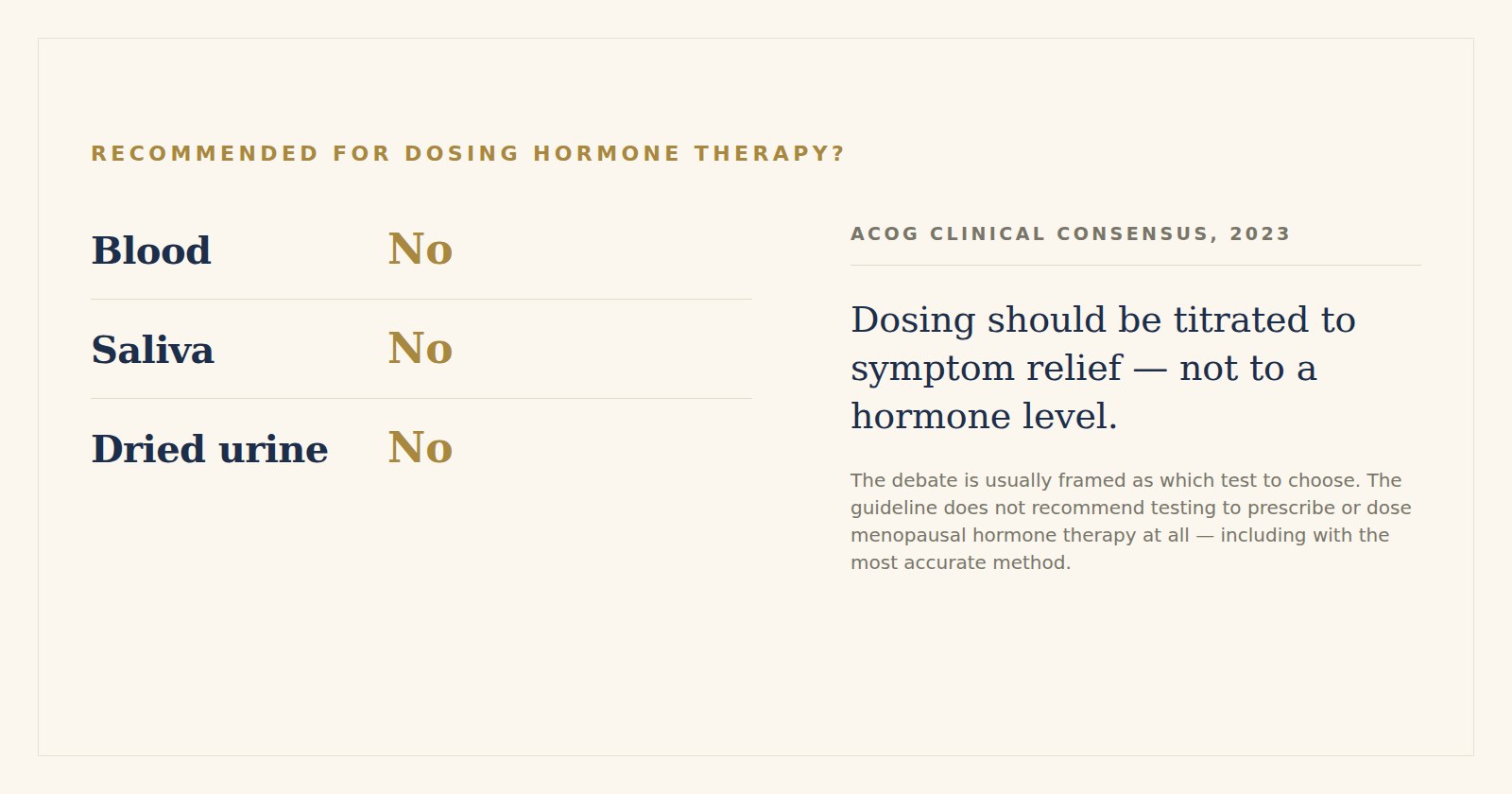
ACOG does not recommend hormone level testing to prescribe or dose menopausal hormone therapy. Its 2023 clinical consensus concludes that data on interpreting hormone level testing for prescribing or dosing is limited, and states that dosing should be titrated to symptom relief rather than to serum levels. That applies to blood testing — the method everyone agrees is the most accurate of the three.
Saliva and dried-urine panels are marketed as more precise than blood, and no major body endorses them for this purpose. ACOG's characterisation of salivary hormone testing is that it is not meaningful, because salivary levels vary with diet, time of day, which hormone is being measured, and other variables.
Put together: a large panel used to “optimise your levels” is answering a question the guidelines do not ask, often using a method they do not endorse. That is an uncomfortable sentence for anyone in this industry to write, including us.
Why levels are a poor guide during the transition
This is the physiological reason underneath everything above, and it is worth understanding rather than taking on trust.
In perimenopause, the ovary does not decline smoothly. It becomes erratic. Estradiol can be higher than it ever was in your thirties one month and low the next. FSH rises overall but swings widely, and a single measurement can land anywhere on that swing. Two blood draws two weeks apart can tell genuinely different stories, and neither is wrong.
That is why STRAW+10 stages the transition by bleeding pattern — the variability in cycle length is a more reliable signal than the hormone concentrations that cause it. We covered what those changes look like from the inside in signs of hormone imbalance in women.
The consequence for testing is direct. A number drawn on a Tuesday describes Tuesday. Building a treatment plan on it, or repeating it to demonstrate that the plan is working, assumes a stability that does not exist in these years.
What ACOG actually says about dosing to levels
The 2023 clinical consensus is about compounded bioidentical menopausal hormone therapy, and one of its clearest positions concerns testing: hormone level testing is not recommended for prescribing or dosing, and dose should be titrated to symptomatic relief rather than to serum levels.
It is worth sitting with what that rules out. It is not only a criticism of saliva kits. It says that the whole model of drawing levels, adjusting a dose to move a number, and re-drawing to confirm — the model a great deal of hormone marketing is built on — is not supported for menopausal hormone therapy, even when performed with the most accurate available method.
The outcome that matters is whether your symptoms improve at a dose you tolerate. That is the endpoint the guideline points at, and it happens to be the one you can actually feel.
What this does not mean
It does not mean bloodwork is pointless, and it does not mean nobody should ever have hormones measured. Both of those are overcorrections, and the distinction matters enough that the rest of this piece is largely about it.
Saliva testing, specifically
Salivary sex-hormone panels have been marketed for menopause and hormone “balancing” for two decades. The professional positions have been consistent across that time.
ACOG has stated that salivary hormone level testing used to tailor therapy is not meaningful, because salivary hormone levels vary within the same woman depending on her diet, the time of day, the specific hormone being tested, and other variables. The North American Menopause Society concluded that salivary testing is not a reliable measure of testosterone levels. Major insurers classify salivary hormone testing for menopause screening, diagnosis or monitoring as experimental and unproven.
The part that makes this fair rather than a blanket dismissal
Saliva is not a useless medium. Late-night salivary cortisol is a legitimate, guideline-endorsed test — it is one of the accepted initial screening tests for Cushing's syndrome, and it is used precisely because cortisol has a strong daily rhythm that a late-night sample captures well.
So the criticism is specific, not general. Saliva works where a well-validated assay exists for a hormone whose behaviour suits the medium. It has not been validated for measuring estradiol, progesterone or testosterone in a way that supports treatment decisions. A laboratory that runs an excellent salivary cortisol and a salivary estradiol panel is doing one validated thing and one unvalidated thing on the same sample.
Dried urine testing
Dried urine panels are newer and increasingly marketed, and they measure something genuinely different: hormone metabolites excreted over a collection period, rather than the hormone circulating at one instant.
The appeal is real in principle. Metabolite patterns can describe how a hormone is being processed, not merely how much is present, and an integrated collection is less hostage to the moment a needle went in than a single blood draw is.
What has not followed is the clinical validation. No major menopause or endocrine body currently recommends dried urine testing to guide menopausal hormone therapy, and there is no established, agreed mapping from a metabolite pattern to a treatment decision. Interesting biochemistry and an actionable clinical test are different things, and the gap between them is where most of the marketing sits.
The honest position is not that these panels measure nothing. It is that nobody has yet demonstrated what to do differently on the strength of the result — and a test that cannot change a decision is not worth paying for.
So when does testing actually help?
Quite often, but usually for a different reason than the one people expect. The value is generally in ruling things out and establishing safety, not in setting a hormone dose.
The pattern in that figure is worth naming. Testing earns its place when there is a specific question with a specific answer — is this premature ovarian insufficiency, is the thyroid responsible, is there anaemia explaining the fatigue. It earns much less when the question is the open-ended one of whether your levels are “optimal,” because there is no agreed definition of optimal to compare against.
The awkward part, since we run labs too
We tell patients that bloodwork comes before treatment. This post says hormone levels are not how menopause is diagnosed or how therapy is dosed. Those need reconciling, so here is the reconciliation.
Baseline labs exist to answer questions about safety and alternative explanations: thyroid function, prolactin where the picture warrants it, blood count and iron, metabolic and liver markers, kidney function. They establish what else could be causing the symptoms and what would make a particular treatment inadvisable.
They are not there to produce a target number for a hormone dose. A practice that draws an estradiol level and adjusts a cream to move it toward a figure on a chart is doing something the guideline does not support, whatever the medium of the test.
If a clinic tells you your panel shows your levels are suboptimal and proposes a protocol to correct them, the question worth asking is: what does the guideline say this number should be, and what happens to my symptoms if we ignore it? There is often no good answer to the first half.
What a useful evaluation looks like instead
- A proper history. Cycle pattern over the last year, symptom onset and course, what has changed and when. This is the diagnostic instrument, not the preliminary to one.
- Targeted tests for mimics. Thyroid disease, anaemia, iron deficiency, sleep disorders and depression all overlap heavily with the menopause transition and are all treatable in their own right.
- Safety labs appropriate to whatever treatment is being considered.
- A symptom-based plan with a defined review point, so that whether it is working is assessed against how you feel rather than against a repeat panel.
- Hormone levels only where a specific question needs them — and with a stated reason.
When to see someone regardless of testing
- Periods stopping before age 40, or becoming very irregular before 45
- Bleeding between periods, after sex, or any bleeding after menopause
- Symptoms severe enough to affect work, relationships or sleep
- A personal or family history of breast cancer, blood clots, stroke or liver disease, before starting any hormone therapy
That third item is worth emphasising: you do not need an abnormal test result to justify treatment, and you should not be told you do.
Where I land
The method matters less than the question. Blood is the most accurate of the three and the guideline still does not recommend dosing to it. Saliva has one validated use in this area and it is not sex hormones. Dried urine is interesting and unproven for guiding therapy.
A panel is not evidence that a clinic is being thorough. Sometimes it is evidence that a clinic has something to sell, and the way to tell the difference is to ask what decision the result will change.
Frequently asked questions
Do I need a blood test to diagnose menopause or perimenopause?
Usually not. The transition is staged primarily by menstrual bleeding pattern and symptoms, which is how the STRAW+10 system works, because hormone levels fluctuate too widely during these years to be reliable. Testing is more useful for ruling out other explanations such as thyroid disease or anaemia, and for specific situations like periods stopping before 40.
Is saliva hormone testing accurate?
Not for sex hormones in this context. ACOG has stated that salivary hormone testing used to tailor therapy is not meaningful, because levels vary with diet, time of day, which hormone is measured and other factors, and the North American Menopause Society concluded it is not a reliable measure of testosterone. Major insurers classify it as experimental for menopause screening, diagnosis or monitoring. Salivary cortisol for Cushing's syndrome screening is a separate, validated use.
What about the DUTCH test or other dried urine panels?
Dried urine testing measures hormone metabolites over a collection period rather than a single circulating level, which is a genuinely different measurement. No major menopause or endocrine body currently recommends it for guiding menopausal hormone therapy, and there is no established mapping from a metabolite pattern to a specific treatment decision. The limitation is not that it measures nothing; it is that what to do differently on the strength of the result has not been established.
Should my hormone doses be adjusted based on my levels?
ACOG's 2023 clinical consensus does not recommend hormone level testing for prescribing or dosing menopausal hormone therapy, and states that dosing should be titrated to symptom relief rather than serum levels. This applies to blood testing, which is the most accurate of the available methods. The endpoint that matters is whether symptoms improve at a dose you tolerate.
Then why do clinics run large hormone panels?
Some are answering specific clinical questions, which is appropriate. Others are using the panel as part of the sales process, because a printout showing numbers outside a range makes a persuasive case for a protocol. The way to tell the difference is to ask what decision the result will change, and what the guideline says the number should be.
When is hormone testing genuinely useful?
When there is a specific question with a specific answer: suspected premature ovarian insufficiency in a woman under 40, unexplained absence of periods, a suspected thyroid or prolactin problem, or an unclear clinical picture that does not fit the usual pattern. It is also reasonable for safety monitoring of particular therapies. It is least useful as an open-ended assessment of whether your levels are optimal, because there is no agreed definition of optimal to measure against.
Before you go
If you are in the menopause transition and being offered an extensive hormone panel, it is entirely reasonable to ask what will be done differently depending on the result. A good answer exists sometimes. When it does not, the panel is not measuring your hormones so much as measuring your willingness to buy a protocol.
DUTCH® is a registered trademark of Precision Analytical, Inc. Billie Jean Health is not affiliated with, endorsed by, or sponsored by that company. It is named here because it is the term patients search for; the discussion applies to dried urine hormone panels as a category.
This article is for general education and is not medical advice for any individual. It doesn't establish a physician-patient relationship. Talk to a licensed clinician about your own situation.