

Last reviewed: September 2026
The short version
Testosterone therapy suppresses sperm production. Not occasionally, not as an unusual reaction — reliably, in most men who take it, as a direct consequence of how it works.
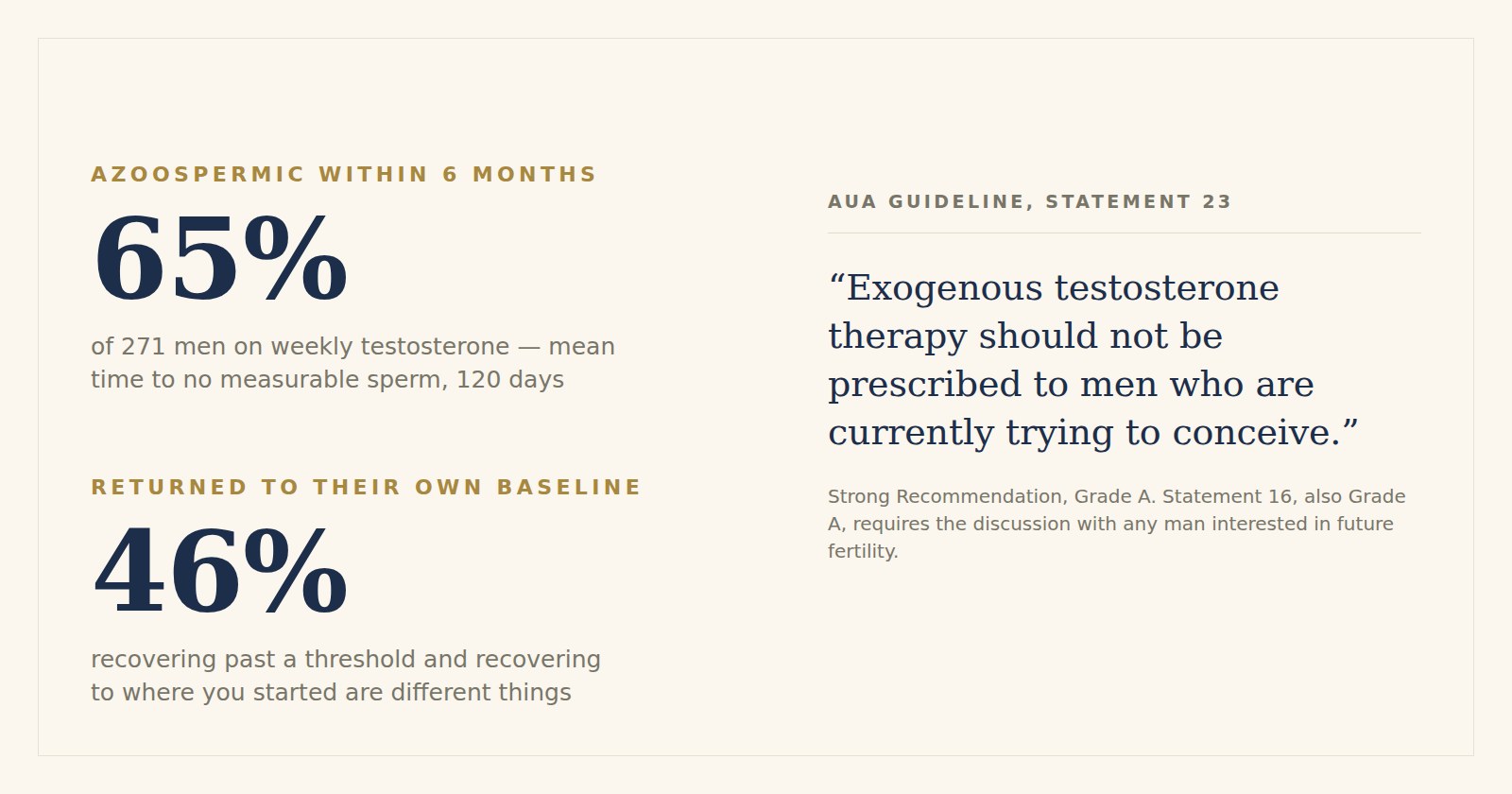
This is not a fringe finding. Testosterone at doses comparable to replacement was studied for years as a male contraceptive, and the reason those trials were run is that it worked. In one World Health Organization study of 271 men, 65% were azoospermic — producing no measurable sperm — within six months, with a mean time to azoospermia of 120 days.
The American Urological Association's guideline is unambiguous about the consequence. Statement 23, a Strong Recommendation graded A: “Exogenous testosterone therapy should not be prescribed to men who are currently trying to conceive.”
Most men do recover after stopping. But “reversible” is doing a great deal of work in that sentence, and the second half of this piece is about what it is actually carrying.
Why it happens
The mechanism is worth understanding, because it explains the part that surprises people most.
Testosterone given from outside produces negative feedback on the hypothalamic-pituitary axis. That suppresses GnRH, which suppresses LH and FSH — the two signals the pituitary sends to the testes. LH tells the testes to make testosterone; FSH supports sperm production.
Here is the crux. Sperm production does not depend on the testosterone in your blood. It depends on intratesticular testosterone — the concentration inside the testis, which is normally many times higher than the level in circulation. Exogenous testosterone raises the blood level while shutting down the local production that maintains the intratesticular level, and spermatogenesis can be dramatically compromised once it falls far enough.
So a man on testosterone therapy can have a serum level that looks textbook-perfect on the printout we described in the piece on reading a result, and a testis that has effectively stopped working. The number on the page and the biology have come apart. Nothing on a standard hormone panel will tell you this has happened. Only a semen analysis will.
What recovery actually looks like
The best data comes from an integrated analysis of thirty male contraception studies, which followed what happened after men stopped.
Read plainly, that is reassuring: essentially everyone got back above the 20 million per millilitre threshold within two years, and the median man took between two and a half and three and a half months depending on which threshold you use.
Two things stop it being as reassuring as it looks.
Recovering to a threshold is not recovering to your baseline
The 20 million per millilitre figure is a reference threshold, not the man's own starting point. In the WHO study, only 46% of participants returned to their baseline sperm density. Getting back above a line and getting back to where you were are different achievements, and most summaries of this literature quietly conflate them.
The men in those studies are not the men taking TRT
This is the more important caveat, and it is almost never stated.
Contraception trials recruit young men with proven or presumed normal fertility, give a defined regimen for a defined period, and stop on a planned date with monitoring built in. Men prescribed testosterone for hypogonadism are typically older, may have impaired sperm production before they start, take it for years rather than months, and often stop without a plan.
None of that means recovery will not happen. It means the recovery figures come from the most favourable population you could construct, and applying them unmodified to a forty-five-year-old who has been on testosterone for six years is an extrapolation, not a finding.
What the guidelines actually say
Four AUA statements bear on this. They are worth reading in the original, because the strength grades matter.
- Statement 23 (Strong Recommendation, Grade A): “Exogenous testosterone therapy should not be prescribed to men who are currently trying to conceive.”
- Statement 16 (Strong Recommendation, Grade A): “The long-term impact of exogenous testosterone on spermatogenesis should be discussed with patients who are interested in future fertility.”
- Statement 10 (Moderate Recommendation, Grade B): “Men with testosterone deficiency who are interested in fertility should have a reproductive health evaluation performed prior to treatment.”
- Statement 27 (Conditional Recommendation, Grade C): “Clinicians may use aromatase inhibitors, human chorionic gonadotropin, selective estrogen receptor modulators, or a combination thereof in men with testosterone deficiency desiring to maintain fertility.”
Notice the shape of that set. The first two are Grade A — the strongest category, and both are about telling the patient. The evaluation before treatment is Grade B. The alternatives are Grade C, conditional, the weakest tier.
In other words: the evidence that this conversation must happen is stronger than the evidence for any particular way around the problem.
The alternatives, honestly
Statement 27 names three categories. All of them are used off-label for this purpose in men, and the conditional grade reflects genuine uncertainty rather than mere caution.
Human chorionic gonadotropin acts on the testis directly, which is why it can maintain intratesticular testosterone where exogenous testosterone suppresses it. Low-dose hCG given alongside testosterone has been reported to preserve semen parameters in hypogonadal men.
Selective estrogen receptor modulators, of which clomiphene is the most discussed, work upstream instead — they raise the body's own LH and testosterone rather than replacing testosterone from outside, which is why they do not carry the same suppressive effect.
Aromatase inhibitors are named in the same statement, but the fertility literature is more cautious about them: routine use is not recommended, in part because the long-term bone-health data is lacking.
Deliberately, this piece does not give doses or protocols for any of them. Which if any is appropriate depends on your semen analysis, your hormone profile, your partner's situation and your timeline, and it is a conversation with a clinician rather than something to assemble from an article.
If fertility might matter to you
The sequence the guidelines describe is a reproductive evaluation before treatment, not after it. That ordering is the whole point — it is much easier to establish where you started while you still have a baseline to measure.
Practical things worth raising:
- A semen analysis before starting, if fertility is on the table at all. Hormone panels do not substitute for it.
- Sperm banking, which is inexpensive relative to the alternatives and removes the timing question entirely.
- Whether testosterone is the right treatment at all — if the goal includes conception, the guideline's answer for men currently trying is no, and the upstream options exist precisely for this situation.
- Your timeline. “Not right now” and “never” are different answers, and only one of them makes this a non-issue.
What a semen analysis actually involves
Worth demystifying, because the vagueness puts men off a test that settles the question in about a week.
It is a single sample, produced privately, delivered to a laboratory within a specified window. The report gives concentration, total count, motility and morphology. It is inexpensive relative to almost anything else in this conversation, and it is the only test that answers the question directly — no hormone panel, however comprehensive, is a substitute.
Because counts vary considerably from sample to sample, an abnormal result is usually repeated before anything is concluded from it. One low reading is not a verdict, in either direction.
Two things men often do not mention
Both are common, both change the picture, and both tend to go unsaid unless asked about directly.
Prior anabolic steroid use. The same mechanism applies, usually at much higher doses and often for years. Azoospermia following anabolic–androgenic steroid use is common enough to have its own clinical literature, and recovery can be slower and less complete than the contraception-trial figures suggest. If this is part of your history it is materially relevant, and a clinician asking about it is doing their job rather than making a judgement.
Testicular size. Many men on testosterone notice their testes become smaller. That is the visible counterpart of everything described above — the testes are receiving less signal and doing less work. It is expected rather than alarming, but it is a reasonable thing to raise, and it is a reminder that the effect is not confined to a number on a lab report.
If you are already taking it
First, this is not an emergency and it is not a reason to stop abruptly on your own. Stopping testosterone has its own consequences, and doing it without a plan tends to produce a bad few months for no additional benefit.
What it is a reason to do is have the conversation you may not have had. A semen analysis tells you where you actually are. Recovery after stopping is likely, and it takes months rather than weeks — the median in the trial data was around three months to the 20 million threshold, with a substantial minority taking a year or more.
If you were never told any of this before starting, that is worth naming plainly: Statement 16 makes the discussion a Grade A recommendation. It should have happened.
Why this sits upstream of everything else
This is one of several reasons a careful practice insists on a full evaluation before treatment rather than a questionnaire and a prescription. The reproductive question has to be asked before the first injection, because afterwards the baseline is gone and the options have narrowed.
It is also why the reversible causes of a low testosterone deserve a proper look first. A man whose level is low because of untreated sleep apnoea, heavy alcohol use or significant excess weight may have a route to feeling better that does not involve suppressing his own axis at all.
Where I land
Testosterone therapy is an effective treatment and, for the man who needs it and is not trying to conceive, the fertility question may be entirely academic. The problem is not the drug. The problem is that this conversation is skipped constantly, in a market where a great many prescriptions are written after a form and a single blood test.
Ask before you start. If you have already started, ask now. A semen analysis is cheap, quick, and the only thing that actually answers the question.
Frequently asked questions
Does testosterone therapy cause infertility?
It suppresses sperm production in most men who take it, which is why testosterone at similar doses was studied as a male contraceptive. In one World Health Organization study of 271 men, 65% were azoospermic within six months, with a mean time to azoospermia of 120 days. The AUA guideline states as a Strong Recommendation that exogenous testosterone should not be prescribed to men who are currently trying to conceive.
Is the effect reversible?
Usually, but the word carries some weight. In an integrated analysis of thirty male contraception studies, the probability of sperm concentration returning to 20 million per millilitre was 67% at six months, 90% at twelve, 96% at sixteen and 100% at twenty-four. However, in the WHO study only 46% of men returned to their own baseline sperm density, and the trial populations were young men with normal fertility on defined regimens with planned stop dates, which is not the typical man on long-term therapy.
How long does recovery take?
In the pooled trial data, median times for sperm concentration to recover to thresholds of 20, 10 and 3 million per millilitre were 3.4, 3.0 and 2.5 months respectively. A meaningful minority take considerably longer, and a small number have prolonged recovery.
My testosterone level is normal on treatment — doesn't that mean my fertility is fine?
No, and this is the most common misunderstanding. Sperm production depends on the testosterone concentration inside the testis, not the level in your bloodstream. Exogenous testosterone raises the blood level while suppressing the signals that maintain the intratesticular level. A normal serum result on treatment tells you nothing about sperm production. Only a semen analysis does.
Are there alternatives that don't affect fertility?
The AUA guideline states that clinicians may use aromatase inhibitors, human chorionic gonadotropin, selective estrogen receptor modulators, or a combination, in men with testosterone deficiency who want to maintain fertility. That is a Conditional Recommendation graded C, the weakest tier, and all of these are used off-label for this purpose. hCG acts on the testis directly; SERMs such as clomiphene raise the body's own production rather than replacing it. Which if any is appropriate is an individual clinical decision.
Should I bank sperm before starting testosterone?
It is worth discussing if fertility is a possibility for you at any point. The guideline recommends that men interested in fertility have a reproductive health evaluation before treatment, and banking removes the timing question entirely. It is a conversation to have with your clinician before the first injection rather than after.
Before you go
If you are considering testosterone therapy and there is any chance you will want to father a child, that belongs in the first conversation, not a later one. If you are already on treatment and this is news to you, a semen analysis is the sensible next step and stopping abruptly on your own is not.
This article is for general education and is not medical advice for any individual. It doesn't establish a physician-patient relationship. Talk to a licensed clinician about your own situation.