

Last reviewed: September 2026
The short version
The usual account of this is that your metabolism slowed down and your weight went up. Both halves of that are close enough to feel true and wrong enough to send you after the wrong thing.
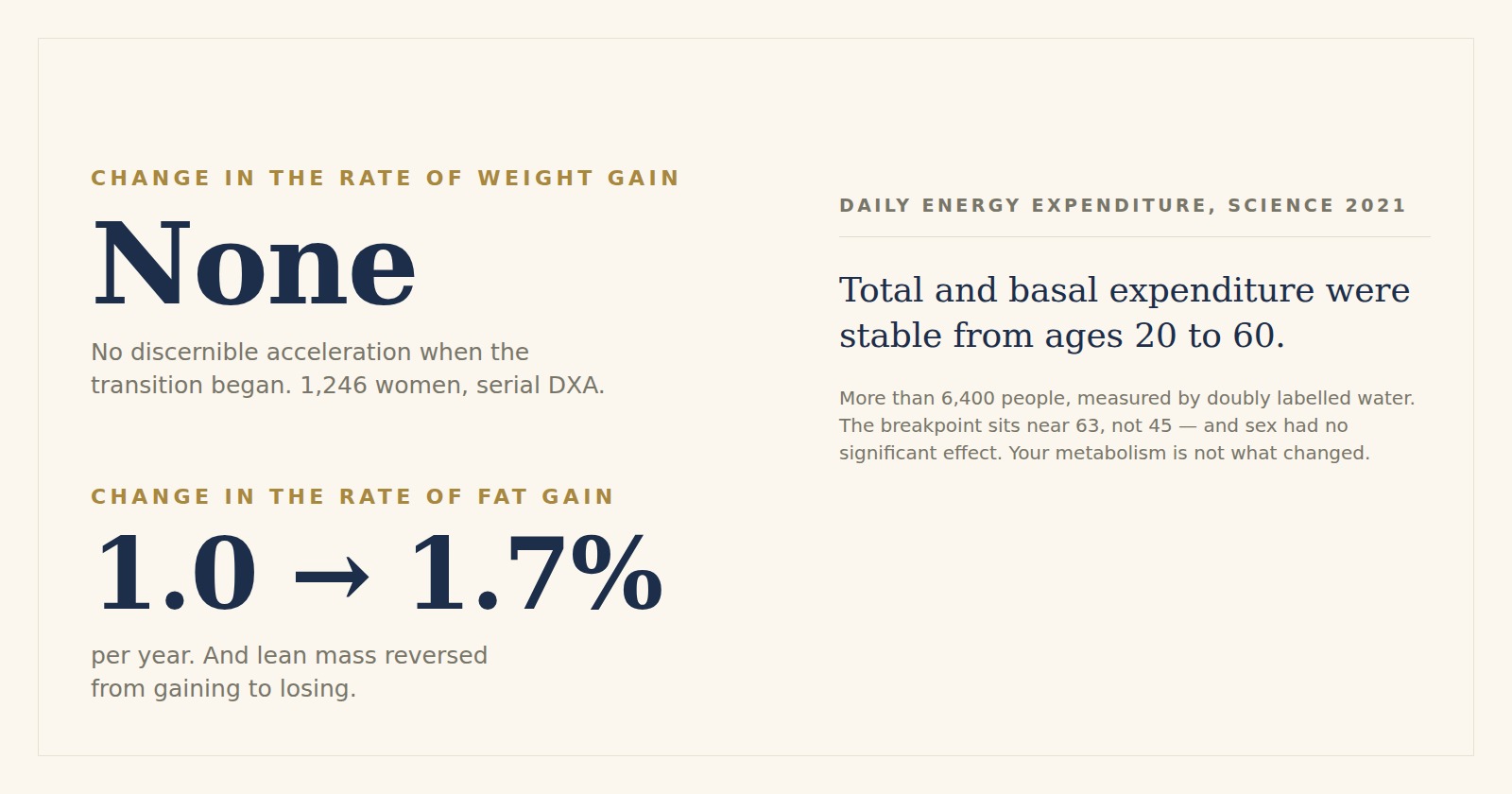
The largest longitudinal study of this transition followed 1,246 women through it with repeated DXA scans. It found that the rate of weight gain did not accelerate when the transition began. Women were gaining weight steadily before it and gaining weight at essentially the same rate during it.
What changed was what the weight was made of. The rate of fat gain nearly doubled. And lean mass, which had been slowly increasing, reversed direction and began to fall.
The two moved in opposite directions at roughly comparable magnitude, which means the scale — the instrument almost everyone is using — registered very little of the thing that was actually happening.
The window is narrower than you think
It is not a decade-long slide. In that study, the acceleration began about two years before the final menstrual period and slowed about a year and a half after it — a window of roughly three and a half years, after which the rates settled again.
Two things follow from that. The first is that this is not a permanent new metabolic state; it is a transition with a beginning and an end. The second is more useful: if you are in it, the window in which the composition change is happening fastest is also the window in which what you do about it counts for most.
Where you are on that timeline is worth establishing rather than guessing, and it is the same question the signs of hormone imbalance piece works through.
Your metabolism did not slow down at 45
This is the belief that does the most damage, because it implies the problem is arithmetic and the solution is to eat less of everything.
In 2021 a consortium published daily energy expenditure measured by doubly labelled water — the reference method — in more than 6,400 people from eight days to 95 years old. After adjusting for fat-free mass, total and basal energy expenditure were stable from age 20 to age 60. The breakpoint at which expenditure starts to decline sits near 63, and the decline after it is about 0.7% a year. Sex had no significant effect in adults across that range, and the authors noted no evidence of a metabolic change at menopause.
The honest complication: a smaller longitudinal study, 156 women followed for four years, did find that sleeping energy expenditure fell somewhat more in the women who became postmenopausal than in those who did not. Both findings can be true. What they add up to is that whatever metabolic shift occurs here is modest, and it is not the main event.
Something else in that smaller study is more actionable, and almost nobody mentions it. Physical activity fell significantly about two years before menopause and stayed low — the same window in which the fat gain accelerates. Activity is measurable, it is modifiable, and it moved first.
Where the fat goes, and which part is menopause
The same study separated two things that usually get discussed as one.
Subcutaneous abdominal fat — the layer you can pinch — increased with age in every woman in the study, whether or not she went through menopause during it. That is chronological aging.
Visceral fat, the deeper fat around the organs, and total body fat increased specifically in the women who became postmenopausal. That is the transition itself.
This is why the shape of the change feels different from any weight you have gained before, and why women describe it as their body redistributing rather than simply enlarging. They are describing something real. It is also why waist circumference is a more informative number here than body weight.
Why the old approach stops working
Whatever you did in your thirties — eat less, do more cardio, watch the scale — is not failing because you have stopped doing it properly. It is failing for three reasons that are specific to this window.
It is aimed at the wrong target. The approach optimises for weight. Weight is the one thing in this transition that is behaving roughly as it always did. Optimising for it means working hard on the measure that changed least.
Energy restriction on its own costs lean tissue, and lean tissue is already falling. Losing weight through eating less alone has always meant losing some muscle along with fat. In this window that loss lands on top of an existing decline rather than on a stable baseline — the mechanism covered in the piece on muscle loss during weight loss.
Success can look like failure. If you replace two kilograms of fat with two kilograms of muscle, you have materially improved your metabolic position and your scale has not moved. Under a weight-based framework, that reads as a wasted three months.
What is actually worth doing
Two things do the most, and both are unglamorous.
Resistance training is the only intervention aimed directly at the thing that changed. It is not cardio with weights and it is not a class; it is progressive loading, two or three times a week, and the case for it is laid out in the piece on training during weight loss. If you do one new thing in this window, this is the one.
Protein intake is what makes the training count, particularly if you are eating less at the same time. It matters most in exactly the combination it is usually skipped in — the specifics are in the protein piece.
Everything else on the list is a supporting player, and worth being clear-eyed about.
Hormone therapy is not a weight loss treatment
It gets sold as one, so this is worth stating plainly.
A systematic review of 28 randomised trials covering 28,559 women found no effect of hormone therapy on body weight, and no evidence that it prevents the increase in BMI that occurs around menopause. A 2026 clinical review reached the same conclusion, describing the effect on total body weight as minimal and clinically insignificant, and stating that hormone therapy is not indicated for weight loss.
What the same review does report is an effect on where the weight sits: attenuation of the increase in total fat mass, reduced visceral fat accumulation, better preservation of lean mass, and a lower waist-to-hip ratio.
So the accurate version is that hormone therapy may change the shape of what happens without changing the number. That is a real benefit and it is not a reason to start it. Whether hormone therapy is right for you is a risk conversation about your own history, and it is its own subject — one that should not be decided on a weight argument in either direction.
If you are on a GLP-1 during this window
Two things are worth knowing, and they point in the same direction.
There is preliminary observational data suggesting postmenopausal women taking hormone therapy lost somewhat more weight on GLP-1 medications than those who were not — around 17% versus 14% with tirzepatide, and 16% versus 12% with semaglutide. These are retrospective analyses with small samples and real potential for confounding, and the review reporting them says so explicitly. It is interesting. It is not a reason to start hormone therapy, and it should not be presented to you as one.
The second point matters more. GLP-1 medications produce weight loss that includes lean tissue as well as fat. In this particular window, that loss is being taken from a reserve that is already declining for a separate reason. It does not make the medication a bad choice. It makes the protein and the training non-negotiable rather than optional, which is the opposite of how they are usually treated.
Hot flashes, sleep and weight
There is a measurable association here, and it is smaller than the internet suggests.
In the same long-running cohort, more frequent vasomotor symptoms were associated with subsequent increases in weight, BMI and waist circumference — on the order of a quarter of a kilogram, and about 3 cm of waist circumference over ten years of frequent symptoms. The authors were careful not to claim causation and noted that sleep is not the only pathway involved.
The sensible reading is that hot flashes and broken sleep are worth treating because they are worth treating, and the options are wider than most women are told. Treating them is not a weight strategy, and anyone selling it to you as one is overstating what the data shows.
What to measure instead
- Waist circumference. Same place, same time of day, once a month. It tracks the visceral change that the scale hides.
- What you can lift. If the weights are going up, lean mass is being defended. This is the most responsive feedback available and it costs nothing.
- How clothes fit at a stable weight. Unscientific, and a genuinely useful signal that composition is shifting under a flat number.
- Body composition testing if you have access to it. DXA is the reference method; consumer bioimpedance scales are far less reliable for a single reading, though more useful for a trend than for a number.
- The scale, weekly at most, read as a trend. It is not useless. It is one number among several, and in this window it is the least informative of them.
When to be seen rather than manage it yourself
- Rapid or unexplained weight change in either direction, which is not attributable to this transition
- Periods stopping before 40, or cycles becoming very irregular before 45
- Any bleeding after menopause, which always needs evaluating and is never attributed to weight change
- Symptoms that look like thyroid disease as much as perimenopause — the two overlap and the workups are different
- Rising blood pressure, blood sugar or lipids alongside a rising waist measurement, which is the combination that matters clinically
- Disordered eating patterns emerging in response to the change, which is common in this window and worth naming early
Where I land
The frustration women describe here is real and the explanation usually given for it is wrong. Your metabolism did not collapse. Your discipline did not lapse. What happened is that the composition of your body began changing faster than it had before, in a window of about three and a half years, while the number you were using to keep score stayed roughly flat.
Which means the honest advice is not to try harder at the old approach. It is to change what you are measuring and change what you are doing — and the two things that move the actual variable are the two that no one has been selling you.
Frequently asked questions
Does your metabolism slow down during perimenopause?
Not in the way the phrase implies. A large study measuring daily energy expenditure by doubly labelled water in over 6,400 people found that total and basal expenditure, adjusted for fat-free mass, were stable from age 20 to age 60, with the breakpoint for decline near 63 and no significant effect of sex. A smaller longitudinal study did find a modestly larger fall in sleeping energy expenditure in women who became postmenopausal. Whatever shift occurs is real but modest, and it is not the main driver of what changes in this window.
Why am I gaining weight in perimenopause when nothing has changed?
In the largest longitudinal study of the transition, the rate of weight gain did not accelerate when the transition began — women were gaining at a similar rate before and during. What changed was body composition: the rate of fat gain nearly doubled, and lean mass reversed from slowly increasing to slowly declining. Because the two moved in opposite directions, the scale reflected very little of it, which is why the change can feel like it appeared from nowhere.
How long does perimenopause weight gain last?
The accelerated phase is narrower than most people expect. In that study the acceleration began about two years before the final menstrual period and slowed about a year and a half after it, then settled. It is a transition of roughly three and a half years rather than a permanent new state.
Does hormone therapy help with menopause weight gain?
Not with weight. A systematic review of 28 randomised trials in 28,559 women found no effect of hormone therapy on body weight and no evidence that it prevents the BMI increase around menopause, and current clinical review describes the effect on total weight as minimal and states that hormone therapy is not indicated for weight loss. It does appear to affect where fat sits — attenuating total fat gain, reducing visceral fat, helping preserve lean mass and lowering waist-to-hip ratio. That is a genuine benefit and it is not a reason to start hormone therapy.
Why is it all going to my middle now?
A longitudinal study that separated the two fat compartments found that subcutaneous abdominal fat increased with age in all women regardless of menopausal status, while visceral fat and total body fat increased specifically in those who became postmenopausal. So the deeper abdominal fat is the part attributable to the transition rather than to age, which is why the change feels like redistribution rather than simply gaining weight.
What should I do differently in perimenopause?
Two things do most of the work: progressive resistance training two or three times a week, which acts directly on the lean mass that is declining, and adequate protein, which is what makes the training count. Then change the instrument — waist circumference monthly and what you can lift are more informative than body weight in this particular window, because weight is the measure that changes least while composition changes most.
Before you go
If you have been working harder for worse results and concluding something is wrong with you, it is worth knowing that the measurement was misleading you before your effort was. The change is real, the window is finite, and the two things that address it are available to you today.
This article is for general education and is not medical advice for any individual. It doesn't establish a physician-patient relationship. Talk to a licensed clinician about your own situation.