

Last reviewed: September 2026
The short version
Almost every woman with hot flashes has been given the same free advice: dress in layers, keep the room cool, avoid your triggers, do some yoga, try slow breathing.
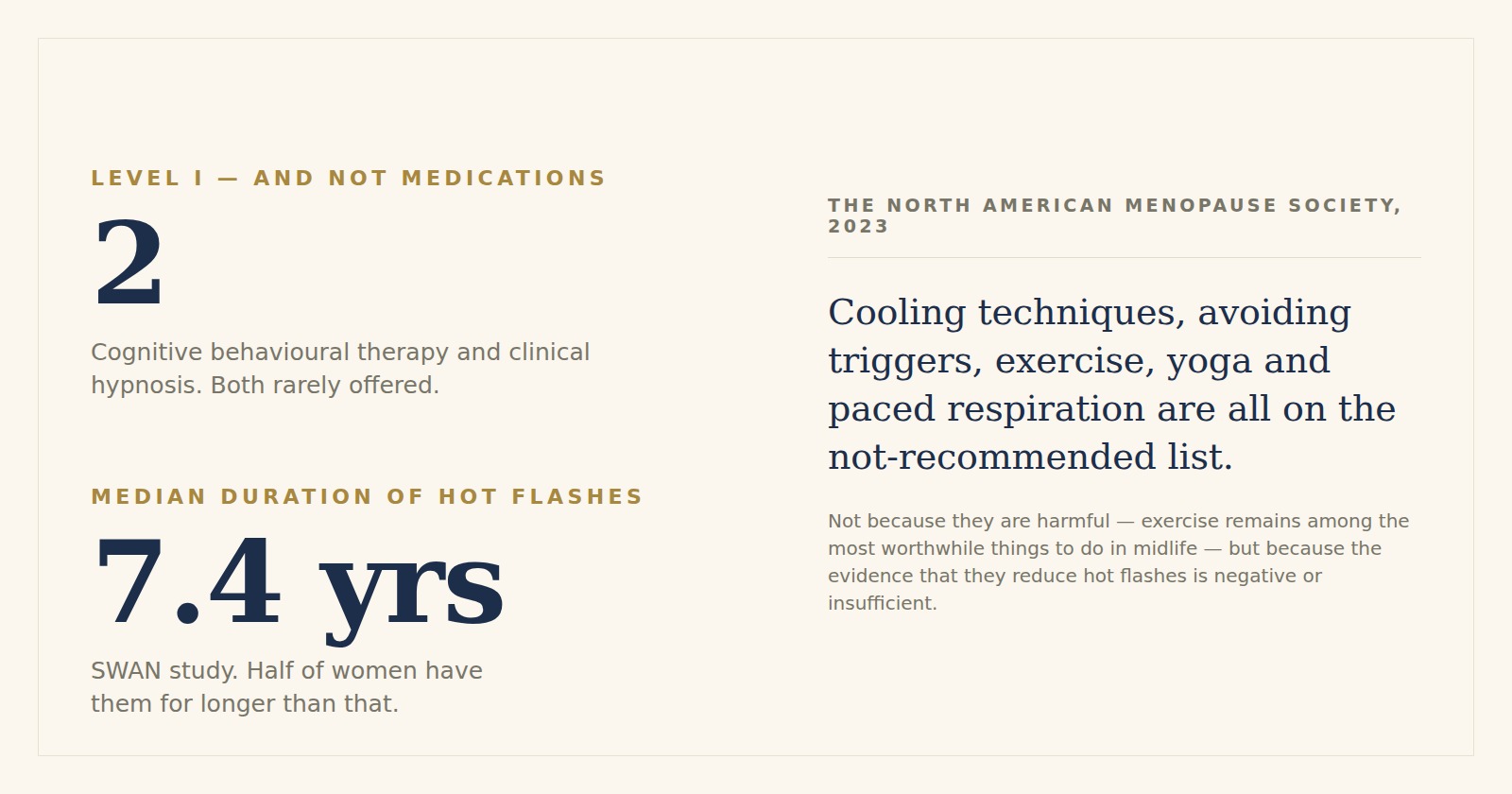
The Menopause Society reviewed the evidence for each of those in 2023 and placed all of them in the not-recommended column — not because they are harmful, but because the evidence that they reduce hot flashes is negative or insufficient. Paced respiration, cooling techniques, avoiding triggers, exercise, yoga, mindfulness, relaxation, dietary modification, soy, acupuncture and herbal supplements all sit on that list.
What it does recommend divides into two groups that most women are never offered. Two of them are not drugs at all: cognitive behavioural therapy and clinical hypnosis, both at the strongest evidence level. The rest are medications, including a genuinely new class that did not exist before 2023.
And the most effective treatment for hot flashes remains hormone therapy — which is a separate question about whether it is right for you, covered in the piece on what the WHI actually found.
An important thing that list does not mean
Before going further: “not recommended” here means not recommended for reducing hot flashes. It is not a verdict on the activity.
Exercise is one of the most valuable things you can do in midlife — for bone density, cardiovascular risk, muscle mass, sleep and mood. Yoga and mindfulness have their own literature. None of that is in dispute, and none of it is undermined by the finding that they do not reliably reduce vasomotor symptoms.
Keep doing them. Just do not conclude that your hot flashes are your fault for not doing enough of them, and do not let “have you tried yoga” be the end of a clinical conversation.
Why the standard advice underperforms
The mechanism explains it, and it is worth a paragraph.
A hot flash is not the body overheating. It is a thermoregulatory misfire. In the hypothalamus, a group of estrogen-sensitive neurons — often called KNDy neurons — help set the range of core temperature the body treats as acceptable. As estrogen falls, that comfortable range narrows dramatically, so a trivial rise in core temperature that used to go unnoticed now trips the full cooling response: flushing, sweating, the heart rate change.
Once you understand that, the free advice makes more sense as a coping strategy than a treatment. A cool room and light clothing make the episode more bearable. They do not widen the range that has narrowed. Avoiding triggers avoids some of the small temperature rises that cross the threshold, without moving the threshold.
This is also why the new drug class works where those do not: it acts on the neurons that set the threshold rather than on the environment around you.
Hormone therapy
It remains the most effective treatment for vasomotor symptoms, and there is no serious dispute about the efficacy question.
The dispute has always been about risk, and that conversation has changed considerably — the FDA removed the boxed warnings from menopausal hormone therapy products beginning in November 2025, with the first batch of relabelled products approved in February 2026. Whether it is appropriate for you depends on your history, your timing and your own risk picture, which is the subject of its own post rather than a paragraph here.
Two things worth knowing in this context. Dosing is titrated to symptom relief rather than to a blood level — there is no target number to chase, as we covered in the piece on hormone testing. And systemic hormone therapy for hot flashes is a different decision from local vaginal estrogen for genitourinary symptoms; a woman may need one, the other, or both.
The new class, and its complication
This is the genuinely new development, and it comes with a caution that most coverage has not caught up with.
Fezolinetant was approved in 2023 as the first neurokinin-3 receptor antagonist for hot flashes. It blocks the signalling at those hypothalamic neurons, which widens the narrowed temperature range rather than managing the consequences. The 2023 position statement recommends it at Level I — the strongest evidence tier.
Elinzanetant followed on 24 October 2025, blocking both neurokinin-1 and neurokinin-3 receptors. It is the second drug in a class that did not exist three years ago.
Now the part that matters. In September 2024 the FDA issued a safety communication about rare but serious liver injury with fezolinetant, and in December 2024 added a boxed warning. Liver blood tests are now required before starting, monthly for the first three months, and again at months six and nine. Treatment is not started if ALT, AST or total bilirubin is at or above twice the upper limit of normal. Elinzanetant carries its own liver testing — before starting and again at three months — and is not to be taken in pregnancy.
Note the sequence: the position statement that recommends fezolinetant at Level I was published in June 2023, and the boxed warning arrived eighteen months later. The recommendation was not wrong when it was made. It simply predates the safety signal, which is a good general lesson about reading any guideline by its date.
None of this makes the class a bad option. It makes it a monitored one, and a clinic that prescribes it without a liver-testing schedule is not following the label.
The two treatments almost nobody offers
Cognitive behavioural therapy and clinical hypnosis both carry Level I recommendations — the same tier as the drugs — and between them they are offered to a vanishingly small proportion of women with hot flashes.
They do not stop the flush occurring. What they reliably change is how disruptive it is: the intensity of the experience, the distress attached to it, and the sleep disturbance that often does more damage than the flush itself. For a woman who cannot take hormone therapy, or does not want to, this is a real option with real evidence behind it rather than a consolation prize.
The practical obstacle is access. Menopause-specific CBT programmes exist and clinical hypnosis has been studied specifically for hot flashes, but neither is widely available, and most clinicians do not think to mention them. Asking directly is usually the only way they come up.
The repurposed medications
Several drugs developed for other purposes have Level I or near-Level I support for vasomotor symptoms.
- SSRIs and SNRIs — antidepressant classes used at doses often lower than those used for depression. Useful particularly where mood symptoms coexist, and an established option for women who cannot take estrogen.
- Gabapentin — often taken at night, where the sedating effect can help the night sweats and the sleep disruption together.
- Oxybutynin — recommended at Levels I to II, though anticholinergic effects need weighing, particularly in older women.
Each has its own side effect profile and interactions, and the choice between them is genuinely individual rather than a ranking.
Two more on the recommended list
Both sit at Levels II to III — supported, but on weaker evidence than the options above — and both are worth knowing about because neither comes up often.
Weight loss is on the recommended side of the ledger. This sits oddly next to exercise being on the other side, and the distinction is real rather than a contradiction: the evidence concerns weight reduction itself, not physical activity as an intervention. It is a slow lever and not a reason to delay treating symptoms that are disrupting your life now, but for a woman who is already working on weight for other reasons, it is reasonable to expect some benefit here too.
Stellate ganglion block is an injection of local anaesthetic near a cluster of nerves in the neck, performed by a pain specialist. It is genuinely a procedure, it is not widely offered for this indication, and it belongs in the conversation mainly for women who cannot take hormone therapy and have not been helped by the options above.
How long does this go on?
Longer than most women are told, which is worth knowing before deciding to simply endure it.
The SWAN study found a median total duration of frequent vasomotor symptoms of around seven and a half years, and women whose symptoms began early in the transition had longer courses. That is a median, so half of women had them for longer.
“It will pass” is true, and it is not a plan for the better part of a decade.
How to work through the options
- Start with how much this is actually costing you. Frequency matters less than disruption — broken sleep and daytime concentration are usually what tip the balance toward treatment.
- Establish whether hormone therapy is on the table for you, because if it is, it is the most effective option and everything else is a comparison against it.
- If it is not, the field is wider than most people are told — two non-drug treatments with Level I evidence, three repurposed medication classes, and a new drug class with two agents.
- Ask what monitoring each option requires before starting it, particularly for the neurokinin antagonists.
- Give any option a fair trial and a review date. Most are assessed over weeks, not days.
When to be seen rather than manage it yourself
- Symptoms severe enough to disrupt sleep, work or relationships
- Hot flashes that start before 40, or that are accompanied by periods stopping early
- Flushing with other symptoms that do not fit — weight loss, diarrhoea, palpitations, or flushing unrelated to temperature, which can point elsewhere
- Any bleeding after menopause, which is never attributed to vasomotor symptoms and always needs evaluating
- Symptoms continuing years past what you expected, which is common and treatable rather than something to accept
Where I land
The most striking thing about this evidence base is the gap between what is recommended and what is offered. The advice given away for free — layers, triggers, breathing, yoga — does not have the evidence behind it. The two non-drug treatments that do are almost never mentioned. And the newest drug class is effective, monitored, and less than three years old.
If you have been managing hot flashes with a fan and a list of foods to avoid, that is not because you have exhausted the options. It is because nobody walked you through them.
Frequently asked questions
Does avoiding triggers help hot flashes?
The 2023 nonhormone therapy position statement of The North American Menopause Society lists avoiding triggers, cooling techniques, paced respiration, exercise, yoga, mindfulness, relaxation and dietary modification among the therapies it does not recommend for vasomotor symptoms, on the grounds of negative or insufficient evidence. This is a statement about hot flashes specifically, not about the value of those activities generally — exercise in particular remains extremely worthwhile for other reasons.
What is the most effective treatment for hot flashes?
Hormone therapy. The question is whether it is appropriate for you, which depends on your medical history, how far you are from menopause and your own risk picture. The FDA began removing boxed warnings from menopausal hormone therapy products in November 2025, with the first relabelled products approved in February 2026, so the risk conversation is different from the one many women had years ago.
What are the new non-hormonal drugs for hot flashes?
Fezolinetant, approved in 2023, blocks neurokinin-3 receptors on the hypothalamic neurons that set the body's temperature threshold. Elinzanetant, approved on 24 October 2025, blocks both neurokinin-1 and neurokinin-3 receptors. Both act on the mechanism causing the flush rather than on the environment around you.
Is fezolinetant safe?
It carries a boxed warning for rare but serious liver injury, added by the FDA in December 2024 after a safety communication in September 2024. Liver blood tests are required before starting, monthly for the first three months, and at months six and nine, and it is not started if ALT, AST or total bilirubin is at or above twice the upper limit of normal. It remains an effective option; it is one that requires monitoring, and the 2023 position statement recommending it predates the warning.
Can therapy really help hot flashes?
Cognitive behavioural therapy and clinical hypnosis both carry Level I recommendations in the 2023 position statement, the same evidence tier as the recommended medications. They do not stop the flush from happening; they reduce how disruptive and distressing it is, including the sleep disturbance. They are rarely offered, so asking directly is usually necessary.
How long do hot flashes last?
The SWAN study found a median total duration of frequent vasomotor symptoms of around seven and a half years, with longer courses in women whose symptoms began early in the transition. Because that is a median, half of women experience them for longer than that.
Before you go
If hot flashes are disrupting your sleep or your working day, that is enough reason to have the conversation — and it is worth going in knowing that the list of real options is considerably longer than the one most women are handed.
This article is for general education and is not medical advice for any individual. It doesn't establish a physician-patient relationship. Talk to a licensed clinician about your own situation.